
8 Creative Writing Prompts for Middle School That Build Real Skills
Struggling to get your middle schooler excited about writing? You're not alone. Too often, passive worksheets and fill-in-the-blank "learning" turn writing into a chore instead of an adventure. But it doesn’t have to be that way. The right creative writing prompts for middle school do more than fill a page; they build agency. They give your child the tools to create, iterate, and own their stories, moving from passive consumption to active creation.
This isn’t about just finishing an assignment. It's about turning their unique ideas into tangible artifacts they can share and be proud of. This process—making, shipping, and reflecting—builds skills that matter far beyond the classroom. In this guide, we'll explore eight types of prompts designed to be doable tonight. You'll find tools for building characters, exploring new worlds, and mastering dialogue, turning writing into productive, satisfying play.
These prompts are designed as short, practical quests. Each one can be a 20-minute activity that results in a finished piece of writing—a character sketch, a scene, or a short story. This approach boosts motivation and helps your child see writing as a series of achievable, creative challenges, not a mountain of homework. Let's dive in.
1. Character Creation & Backstory Building
Great stories begin with compelling characters. This prompt challenges your middle schooler to become a character architect, building an original person from the ground up by defining their history, personality, fears, and dreams. This process is foundational for narrative writing, teaching kids that a character's actions are driven by their past experiences and internal motivations.
This approach helps students see characters not as plot devices, but as individuals with agency. By building a detailed backstory, they learn to write characters whose choices feel earned and believable.
How to Start Tonight
- Time: 20 min • Materials: Pen and paper, or a notes app • No-kit option: Just talk it through together.
- The Quest: Create a character profile for a new hero or villain.
- Step 1: Start with an "interview." Ask your child to answer questions from the character's perspective: What is your biggest secret? What is your happiest memory? What do you want more than anything else?
- Step 2: Create a quick visual map. Encourage your child to sketch or find images that represent the character's home, style, friends, and inner thoughts. For fantasy or sci-fi characters, exploring a Dnd Character Image Creator can be an exciting way to visualize unique traits.
- Step 3: Ask a reflective question to connect the dots. "You wrote that your character is brave. Describe a memory from their past that made them this way."
- Feedback Prompts: "Show me the first draft of your character. What's one detail you'll add to make them more interesting?" or "Where did you get stuck and how did you unstick it?"
By focusing on who a character is before what they do, you equip your child with a powerful tool for crafting richer, more empathetic stories. This is one of the most effective creative writing prompts for middle school because it builds the bedrock of all narrative fiction.
2. "What If" Scenario & World-Building Prompts
This prompt transforms your child from a storyteller into a world architect. By asking a single "what if" question, they can construct entire societies, ecosystems, and histories from scratch. This process develops imagination and systems thinking as they explore the consequences of one fundamental change.
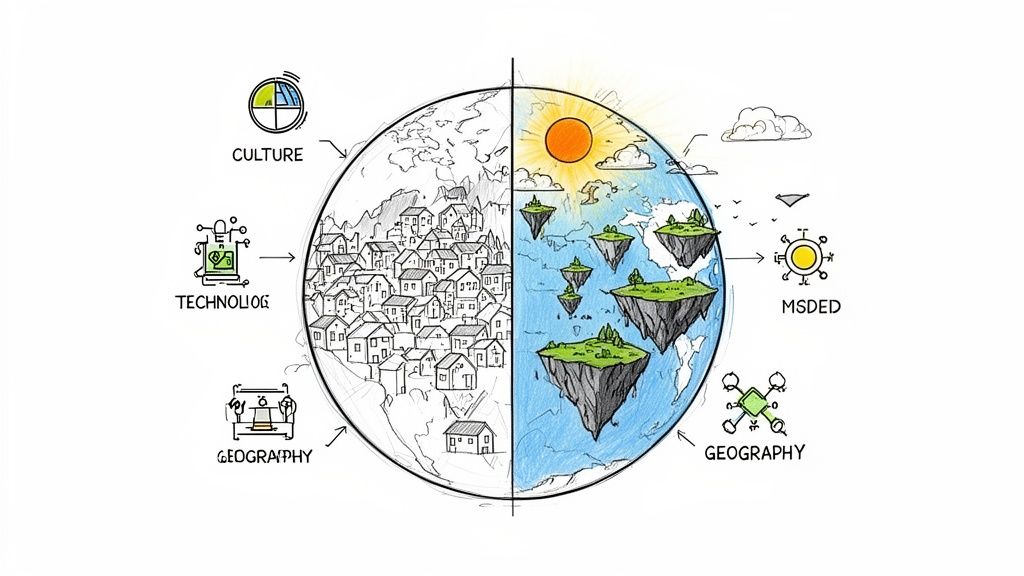
This exercise teaches students that compelling settings are more than just backdrops; they are active forces that shape characters and drive conflict. By building their own worlds, students learn to create immersive and internally consistent narratives.
How to Start Tonight
- Time: 20 min • Materials: Whiteboard or large paper, markers • No-kit option: Use a notes app to create a bulleted list.
- The Quest: Design a new world based on one "what if" question.
- Step 1: Start with one changed element. Ask your child to pick just one thing to change about our world. What if gravity was half as strong? What if humans could communicate with animals?
- Step 2: Brainstorm the consequences. Use a simple mind map to explore how that single change would affect categories like: Geography, Government, Culture, and Daily Life.
- Step 3: Visualize one part of the world. Encourage them to sketch a quick map, design a flag, or draw a key location. Exploring why storyboarding is a superpower for young creators can provide useful visual planning techniques.
- Feedback Prompts: "Show me your v1 world map. What will you change in v2 to make it feel more real?" or "Which rule of your new world was hardest to figure out?"
"What if" prompts are some of the most powerful creative writing prompts for middle school because they build the stage upon which epic stories can unfold, fostering creativity and critical thinking simultaneously.
3. Personal Narrative & Memoir Writing
This prompt invites middle schoolers to become the main characters of their own stories. By exploring meaningful personal experiences, they learn to transform memories into compelling narratives. This exercise helps them find their unique voice and build confidence by honoring their individual experiences.
Moving away from the passive, one-size-fits-all worksheets common in the legacy school model, this prompt centers the child's agency and perspective. By focusing on a small, significant moment, students learn that a single memory can reveal universal themes of growth, challenge, or joy.
How to Start Tonight
- Time: 20 min • Materials: A quiet space, journal or document • No-kit option: Use a voice recorder to tell the story out loud first.
- The Quest: Write a one-page story about a single, vivid memory.
- Step 1: Focus on a "small moment." Guide your child to zoom in on a specific memory: the moment they finally landed a difficult skateboard trick, a conversation that changed their perspective, or the feeling of stage fright before a performance.
- Step 2: Use sensory details. Encourage them to relive the moment through their five senses. What did they see, hear, smell, taste, and feel? This makes the memory come alive for the reader.
- Step 3: Model vulnerability. Share a short, simple story of your own first. This creates a safe environment and shows that everyone has stories worth telling.
- Feedback Prompts: "I love how you described the sound of the crowd. What feeling were you trying to create?" or "Which part of this story was the most important to you, and why?"
This is one of the most impactful creative writing prompts for middle school because it validates a child’s personal history and teaches them to find the extraordinary in their everyday lives. It builds a foundation for authentic expression and empathetic storytelling.
4. Dialogue & Conversation Writing Prompts
Great stories let us hear characters speak. This prompt zeroes in on the art of conversation, challenging middle school students to reveal personality, conflict, and emotion using only dialogue. By isolating conversation as a core skill, students learn that what characters say (and what they don't say) is just as powerful as what they do.
This focus helps students understand that dialogue is action. Young writers learn to "show, don't tell" in one of its most effective forms, creating characters whose voices are distinct and memorable.
How to Start Tonight
- Time: 10 min • Materials: Paper and pen • No-kit option: Act out the scene together.
- The Quest: Write a short scene using only dialogue.
- Step 1: Use a conversation starter. Provide a single line of dialogue and ask your child to write the scene that follows. Examples include: "You promised you wouldn't tell anyone." or "That's not what happened, and you know it."
- Step 2: Try anonymous dialogue. Ask your child to write a conversation between two characters without using names or dialogue tags ("he said," "she asked"). The challenge is to make each voice so distinct that a reader can tell who is speaking.
- Step 3: Listen to the real world. Encourage your child to be a "dialogue detective" for a day. Have them listen to how people really talk and jot down interesting phrases to make their own writing feel more authentic.
- Feedback Prompts: "Which character's voice was easier to write, and why?" or "Read this line out loud. How could you change it to sound more like a real person talking?"
This is one of the most practical creative writing prompts for middle school because it connects directly to daily life and sharpens an ear for authentic communication.
5. Genre Mashup & Creative Constraint Prompts
This prompt challenges middle schoolers to break storytelling rules by combining unexpected genres or writing within tight limitations. By mixing a western with sci-fi, or a comedy with horror, students are forced to think critically about the conventions of each genre and invent something new.
Constraints, like writing a story with no dialogue or in a single room, act as creative catalysts. Instead of being limiting, these rules force writers to find new ways to show emotion and build tension. These types of creative writing prompts for middle school teach students that innovation often comes from working within a defined framework.
How to Start Tonight
- Time: 20 min • Materials: Two dice or slips of paper • No-kit option: Use an online random word generator.
- The Quest: Write a short story opening that combines two different genres.
- Step 1: Create "genre dice." Write different genres on slips of paper (fantasy, sci-fi, mystery, romance, western, horror). Have your child pick two at random to get a combination, like "fantasy noir" or "romantic horror."
- Step 2: Set a clear constraint. Provide a specific, non-negotiable rule. Examples include: write a 100-word story, tell a story only through text messages, or describe a dramatic event from the perspective of an inanimate object.
- Step 3: Brainstorm the core elements. What are the key ingredients of each genre? A mystery needs a clue; a western needs a dusty town. How can they be combined?
- Feedback Prompts: "I love how you blended the detective's attitude with the magical setting. What was the hardest part of mixing those two?" or "Show me your favorite mistake and what it taught you."
By introducing constraints, you help your child develop a more flexible and inventive approach to storytelling, moving them away from formulaic narratives and toward genuine originality.
6. Story from Different Perspectives & Multiple POV Prompt
A single event feels completely different depending on who experiences it. This prompt challenges middle school writers to step into multiple characters' shoes and retell the same scene from their unique viewpoints. It’s an exercise in empathy and critical thinking, teaching students that perspective shapes reality.
This prompt is crucial for developing sophisticated storytelling skills. It shows young writers how an author can create tension, mystery, or humor simply by controlling whose eyes the reader sees through. The story of the Three Little Pigs changes dramatically when told from the wolf's perspective.
How to Start Tonight
- Time: 20 min • Materials: A notebook with columns for each character • No-kit option: Tell the different versions of the story out loud.
- The Quest: Retell a simple event from two different points of view (POVs).
- Step 1: Start with a shared scene. Begin with a simple event, like a surprise party, a dropped ice cream cone, or a classroom incident.
- Step 2: Assign character roles. Have your writer choose 2 characters who were present (e.g., the birthday girl and a guest who feels left out). Have them rewrite the scene from each character's first-person POV.
- Step 3: Compare and contrast. Discuss what changed. How did the birthday girl’s description of the party differ from the lonely guest’s? What words did each character focus on?
- Feedback Prompts: "Which character's story do you trust the most, and why?" or "Show me v1 from the hero's perspective. How will you change it for v2 from the villain's perspective?"
By practicing with multiple points of view, you give your child a powerful tool for crafting complex characters and dynamic plots. This is one of the most effective creative writing prompts for middle school because it teaches them to think like an author, an analyst, and a psychologist all at once.
7. Sensory & Descriptive Writing Prompts
Many middle school writers focus on what happens, leaving their scenes feeling generic. This prompt isolates one powerful skill: using rich sensory details to pull the reader into the story. By concentrating on sight, sound, smell, taste, and touch, students learn to build immersive worlds.
This approach helps students understand that atmosphere is as crucial as plot. A simple description of the way dust motes dance in a sunbeam or the sticky feel of a rusty handle can convey more emotion than pages of explanation.
How to Start Tonight
- Time: 10 min • Materials: Pen and paper • No-kit option: Describe a room or an object out loud using only one sense.
- The Quest: Write one paragraph describing a place using three of the five senses.
- Step 1: Assign a sensory focus. Challenge your child to describe a crowded market using only sounds, or a forest after rainfall using only smells. This constraint forces creativity.
- Step 2: Conduct a 'sensory scavenger hunt.' Have your child sit in their room and list five things they can see, four they can hear, and three they can feel. Use this list as the raw material for a descriptive paragraph.
- Step 3: Avoid clichés. Instead of "the sun was hot," ask questions that prompt specificity: Did it feel like a warm blanket or a prickly sting?
- Feedback Prompts: "Your description of the smell made me feel like I was really there. What sight could you add to make it even stronger?" or "Which sense was the easiest to write about?"
Mastering sensory details is one of the most effective creative writing prompts for middle school because it elevates writing from a simple report of events to an immersive experience.
8. Collaborative & Interactive Story Building Prompts
Writing is often a solo activity, but this prompt transforms it into a team sport. Collaborative storytelling challenges middle schoolers to build a narrative together. Whether each person adds a paragraph or a sentence, this prompt develops skills in adaptability, communication, and building on others' ideas.
This method teaches writers to be flexible and responsive. They learn to let go of total control and embrace the surprising turns a story takes when guided by many hands.
How to Start Tonight
- Time: 15 min • Materials: A shared document (like Google Docs) or paper passed around • No-kit option: Do it verbally.
- The Quest: Create a short story together, with each person adding one sentence at a time.
- Step 1: Try "Exquisite Corpse." One person writes the first paragraph of a story and folds the paper to hide what they wrote, leaving only the last sentence visible. The next person continues the story, and so on. The final reveal is often hilarious.
- Step 2: Run a round-robin story. Sit in a circle. One person starts a story with a single sentence. The next person adds a sentence, continuing around the circle.
- Step 3: Establish clear guidelines. Before starting, agree on basic rules. Define the genre and main character. Set a length for each contribution (e.g., "each person adds one sentence") to ensure everyone participates equally.
- Feedback Prompts: "Which turn did the story take that you didn't expect?" or "How did your idea change based on what the person before you wrote?"
By turning storytelling into a shared experience, these creative writing prompts for middle school foster collaboration and active listening. Students learn to appreciate diverse ideas and practice building something greater than they could have alone.
From Prompt to Portfolio: Making Writing Stick
We’ve explored a range of creative writing prompts for middle school, but the true value of these exercises is building a confident, high-agency learner. The goal isn't just to complete an assignment. It's to kickstart a powerful cycle of making, shipping, and reflecting. Passive, one-size-fits-all worksheets can drain creativity, but a well-chosen prompt invites your child to take charge.
Turning Practice into a Powerful Portfolio
Think of each written piece as an artifact—a snapshot of your child's thinking and unique voice. When collected, these artifacts tell a compelling story of growth.
- Create a Living Portfolio: A simple digital folder or a physical binder is all you need. Encourage your child to save their work, from messy first drafts to polished final versions. This makes progress visible and serves as a powerful source of pride.
- Focus on the "Why": Shift the conversation from "Is it done?" to "What did you discover?" A portfolio isn't just a gallery of finished products; it’s a record of the journey.
If you like project-based learning but want it doable at home, Kubrio handles the planning and feedback so you can focus on building and reflecting together.
The Art of Actionable Feedback and Reflection
Generic praise like "good job" is a dead end. Instead, use targeted questions to encourage iteration and deeper thinking.
Actionable Next Steps for Parents:
- Select a Prompt Weekly: Choose one prompt that aligns with your child's interests. Frame it as a low-stakes, 20-minute challenge.
- Document Version 1: Have them spend 20 minutes on a first draft. The key is to get ideas down without worrying about perfection. Take a picture or save the file.
- Ask "What's Next?" Questions: Use these prompts to guide their revision process:
- “Show me your favorite part. What makes it strong?”
- “Where did you get stuck? What’s one small change you could make to get unstuck?”
- “What will you do differently in your next version?”
- Capture Version 2: After incorporating feedback, have them create a revised draft. Save this version next to the first one in their portfolio.
- Hold a Brief Reflection: End the session with two simple questions:
- “What changed between v1 and v2?”
- “Which step took the most effort, and what would you try next time?”
By embracing this cycle, you transform a simple list of creative writing prompts for middle school into a dynamic toolkit for building resilience, critical thinking, and a profound sense of ownership. Your child isn't just writing stories; they are writing their own story of growth, one draft at a time.