
How to Build Confidence: It’s Not What You Think
We’ve been sold a myth about confidence. We see it as a personality trait—something you’re either born with or you’re not. If you're waiting for your child to simply feel confident one day, you’ve got the formula backward.
Lasting confidence isn't about affirmations or telling your kids they’re great. It’s built, not born. It's the quiet result of trying, failing, learning, and finally, doing.
The True Foundation of Lasting Confidence

Real self-assurance isn’t wishful thinking. It’s an internal knowledge that says, "I've handled something like this before. I can handle it again."
That feeling isn't magic. It’s forged in the small, repeated cycles of effort and eventual success. Confidence isn’t the starting line; it’s what you find at the finish line.
Competence Breeds Confidence
Think about learning to ride a bike. No amount of "You can do it!" will teach a child to balance. Confidence only clicks into place after they wobble, fall, get back on, and finally feel the wheels rolling steady beneath them.
The act of doing creates the belief.
This simple truth applies to everything, from navigating friendships to solving a math problem. Every small win provides tangible proof of their capability. Psychologists call these mastery experiences, and they’re the single most powerful source for building a child's belief in themselves.
The biggest mistake is thinking confidence is a prerequisite for action. In reality, action is the prerequisite for confidence. You act your way into a new way of feeling.
As parents, our job is to be architects of these experiences. It’s not about shielding our kids from struggle. It's about creating a safe space for them to take on manageable challenges.
This is where a growth mindset is everything—the belief that you can get better with effort. When we focus on the process instead of just the final grade, we teach them that hard work is the path to getting good at something. You can find some great ways to nurture this in our guide on growth mindset activities for kids.
To help you get started, here’s a breakdown of the key areas to focus on.
Core Pillars of Childhood Confidence
| Pillar | What It Means | Why It Matters for Confidence |
|---|---|---|
| Action & Experience | Creating opportunities for kids to try, fail, and succeed on their own terms. | Competence is the bedrock of confidence. Real-world "wins," no matter how small, provide proof of capability. |
| Effort over Outcome | Praising the hard work, persistence, and strategies used, not just the final result. | This teaches children that their abilities are not fixed and that they have control over their own growth. |
| Resilience & Setbacks | Framing mistakes as a normal, necessary part of the learning process. | Normalizing failure removes the fear of trying and encourages kids to tackle bigger challenges. |
By focusing on these pillars, you shift your role from being a cheerleader to a coach. You’re not just shouting encouragement from the sidelines; you’re setting up the practice field, giving them the right tools, and designing the drills that build real skills—and with them, a lifetime of genuine confidence.
Create a Safe Space for Failure and Growth

Real, lasting confidence isn't about avoiding mistakes. It’s forged in the messy, often frustrating process of picking yourself up after you fall down.
Think about it: a child who is terrified of failing will never take the risks needed to learn something truly new. They’ll stick to the safe path. Our job as parents is to build a psychological safety net—an environment where trying hard and falling short isn't just okay, it's celebrated as part of the game.
It all starts by separating the failure from your child’s identity. When a LEGO tower collapses or a soccer game is lost, that’s just an event. It's a data point, not a verdict on their character.
Separate the Action from the Identity
The words we use have immense power. They can either cement a fixed mindset ("I'm just bad at this") or nurture a growth mindset ("I can get better at this"). The trick is to always focus on the strategy, never on the person.
This one simple shift changes everything. It moves the conversation from some innate, unchangeable ability to the choices they made along the way—choices that are always within their control. It's the difference between feeling helpless and feeling empowered.
Here's what that sounds like in real life:
-
Instead of: "You failed the test."
-
Try: "That study method didn't get the result we wanted. What's another way we could try studying for the next one?"
-
Instead of: "You're so clumsy."
-
Try: "Oops, that glass slipped! Let's clean it up together. We all have accidents."
-
Instead of: "You're just not a soccer player."
-
Try: "That was a tough game. What's one skill you want to practice this week to feel a little stronger out there?"
This kind of reframing is how you teach a child how to build confidence from the inside out. They learn that setbacks aren't proof of their limits; they're just problems waiting to be solved.
Model Your Own Healthy Reactions
Kids are expert observers. They learn far more from watching you handle your own frustrations than from any lecture you could ever give. What do you do when you burn dinner, make a mistake at work, or get hopelessly lost?
Do you get angry, blame yourself, and spiral? Or do you take a deep breath, maybe even laugh it off, and pivot to a solution? Your response becomes their internal script for dealing with adversity.
When a parent can say, "Wow, I really messed that up. Oh well, let's figure out how to fix it," they give their child a powerful gift: the permission to be imperfect.
Admitting your own mistakes shows them that everyone struggles. It normalizes trial and error, stripping away the shame and fear that so often paralyze kids. Being transparent about your own imperfect journey is one of the most powerful ways to build their resilience.
Turn Challenges into Exciting Opportunities
A growth mindset sees a challenge not as a threat, but as an interesting puzzle to be solved. This perspective is the engine that drives curiosity and persistence. When a child approaches a difficult task like an adventure instead of a test, their entire energy shifts.
You can nudge them toward this mindset by how you frame things:
- "This new coding project looks tricky! I wonder what new things we'll discover while we figure it out."
- "Learning this new song on the piano is going to be a fun challenge. Let's break it down, one note at a time."
When kids feel safe enough to try, fail, and try again, they build the courage to take on bigger and bigger challenges. This creates an amazing upward spiral: effort leads to competence, and that hard-won competence creates the unshakable, authentic confidence we all want for them.
Engineer Small Wins Through Manageable Challenges
Big, intimidating goals are confidence killers. When a child looks at a massive project—like cleaning their entire room, acing a science fair, or learning to code—their brain often just freezes. The finish line feels a million miles away.
But here’s the thing: real confidence isn’t built by staring up at the mountain. It’s built by taking the first small, successful step. Then another. And another.
The secret is to stop thinking like a cheerleader and start thinking like an engineer. Your job isn’t just to offer encouragement from the sidelines; it’s to break that mountain down into a series of small, rewarding hills. This is the most reliable way to build genuine confidence, because it quite literally manufactures momentum.
The Psychology of the Small Win
Every time your child successfully finishes a small task, their brain releases a little bit of dopamine, a chemical tied directly to motivation and reward. This isn't just a nice feeling; it's a powerful biological reinforcement loop.
Success, no matter how small, sends a clear signal to the brain: "I did that. I can do it again." This creates an incredible upward spiral. Tiny wins stack up into undeniable proof of their own capability, which is the very essence of confidence.
Think of it like a video game. The best game designers would never throw a new player into the final boss battle. Instead, they give you a simple task, reward you for it, and then slowly dial up the difficulty. This design keeps players feeling competent and engaged every step of the way.
The visual below breaks down how you can turn any big goal into a series of these confidence-boosting micro-tasks.
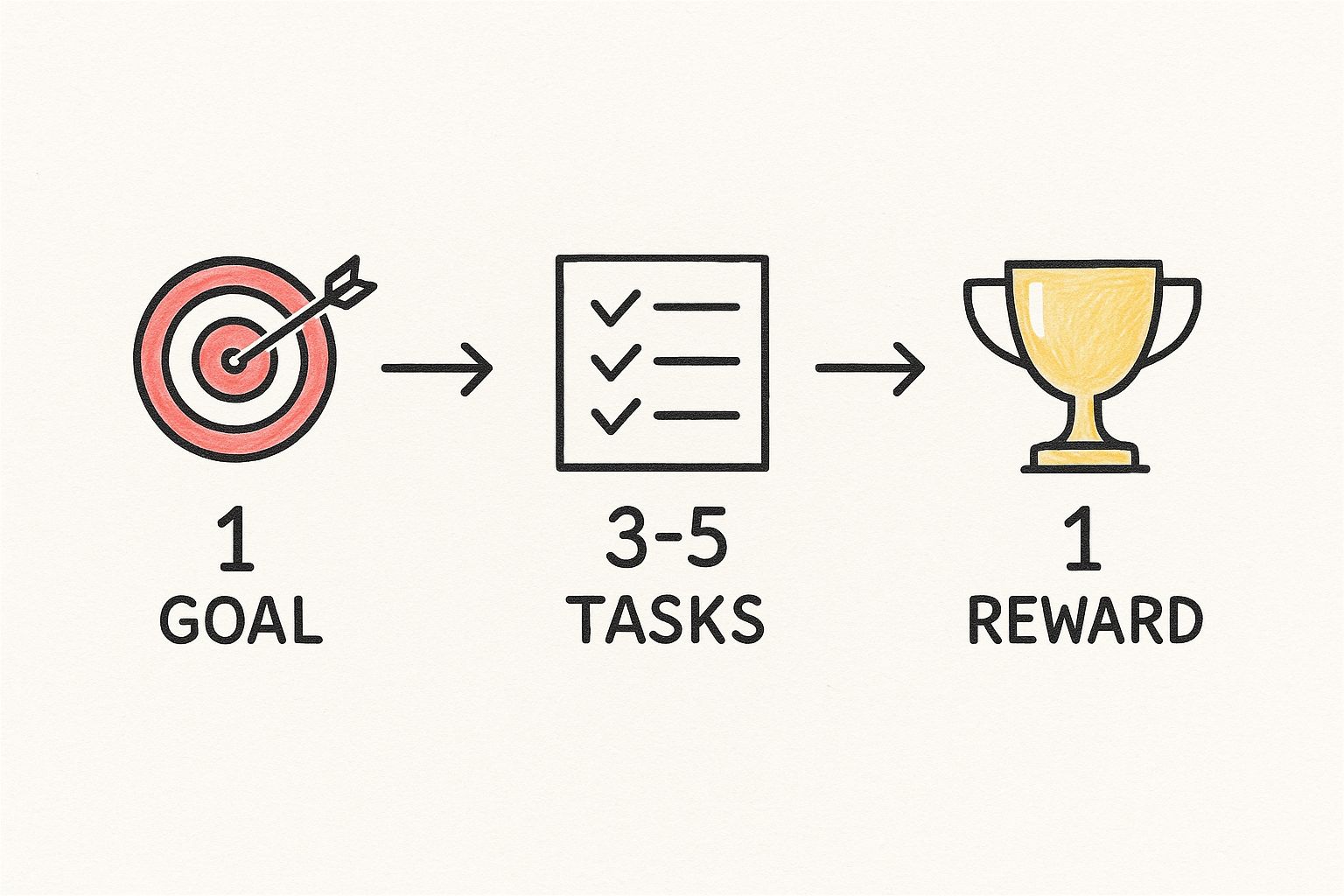
This framework isn't complicated. It's about deconstructing a single big objective into a few concrete actions, then celebrating the completion to reinforce the positive experience.
From Overwhelmed to Actionable
So, how do you put this into practice? The key is to always define the very next physical action your child can take. Forget the big picture for a moment and focus on the immediate step.
Big Goal: Clean the messy bedroom.
- The Overwhelming Way: "Go clean your room!"
- The Engineered Way:
- First, just put all the dirty clothes in the hamper. (Win #1)
- Next, gather all the LEGOs and put them back in the bin. (Win #2)
- Finally, make the bed. (Win #3)
Big Goal: Learn a new skill, like soccer.
- The Overwhelming Way: "Become a good soccer player."
- The Engineered Way: Focus on mastering one specific move until it feels easy. For a great example of how these small wins build on each other, check out these essential soccer drills for beginners to improve confidence.
The objective isn't just to get the task done. The real goal is to make your child feel successful while they're doing it. The process matters far more than the immediate outcome.
This approach shifts the focus from an intimidating final product to an achievable next step. It’s a game-changer because it works for absolutely anything, from schoolwork to personal hobbies.
Celebrating the Process Builds Resilience
Finally, make it a habit to celebrate these small steps. The reward doesn’t need to be huge—a high-five, specific praise about their effort, or five extra minutes of screen time works wonders.
What you're really celebrating isn't just the finished task, but the process of breaking down a problem and seeing it through. You're reinforcing the habit of persistence.
When kids truly learn that they can conquer big things by tackling them in small pieces, they gain a superpower. They develop an internal belief that no challenge is too big if they can just find the right first step. That isn’t just confidence—that’s agency. And it’s a skill that will serve them for life.
Help Your Child Navigate Social Fears

Mastering a new skill is one thing. But taking that skill out into the wild, unpredictable world of friendships, group projects, and playground politics? That’s where confidence is truly tested.
This is where the rubber meets the road. Navigating social dynamics is where self-belief is forged, and for a lot of kids, it’s downright terrifying. A paralyzing fear of being judged or left out can unravel all the confidence they’ve built in other areas.
But here’s the thing: social skills aren’t some magical trait kids are born with. They’re learned. We can teach our kids how to start a conversation, read a room, and handle a disagreement, just like we teach them to ride a bike. This is a non-negotiable step in learning how to build confidence that actually sticks.
From Social Fear to Social Competence
Let’s be clear, social anxiety is more than just being shy. It’s a powerful feeling that can chip away at a child’s sense of self-worth. It’s a huge factor in undermining confidence, affecting about 7.1% of the population at any given time, according to findings from the American Psychiatric Association.
The fear of being scrutinized turns simple interactions into high-stakes performances, especially during those crucial adolescent years when they’re figuring out who they are.
Our job isn’t to be a social director, making friends for them. It’s to be their guide—equipping them with the tools and the practice they need to feel capable on their own.
You can start small. Forget the chaotic, overwhelming birthday party for now. How about a one-on-one playdate with a classmate who also loves building LEGOs? The idea is to stack the deck in their favor, creating opportunities for positive social moments that feel totally manageable.
Practical Tools for Social Success
Telling a nervous kid to "just go make friends" is about as helpful as telling them to just grow wings and fly. They need concrete strategies, not vague platitudes.
This is where role-playing at home becomes your secret weapon. Make it a game, keep it light, and walk through different scenarios. What do you say when you want to join a game on the playground? How do you introduce yourself to someone new?
Here are a few specific strategies you can practice together:
- The "Question and Listen" Opener: Teach them to kick off conversations with open-ended questions. Instead of, "Do you like video games?" (which only gets a "yes" or "no"), try something like, "What's your favorite thing to do after school?" It invites a real answer and shows they’re genuinely interested.
- The "Find a Similarity" Technique: Encourage them to be observers. Do they see a kid wearing a Minecraft shirt? Or playing with a toy they also have? Pointing out something you have in common is one of the most natural ways to spark a connection.
- The "Graceful Exit" Plan: Sometimes the anxiety isn't about starting a conversation, but not knowing how to end it. Practice simple lines like, "It was cool talking to you! I'm going to go find my mom now." Having an exit strategy makes the whole thing feel less intimidating.
Confidence in social settings comes from having a toolbox of strategies. When kids know what to do, they feel less anxious about the unknown.
Navigating Disagreements and Social Cues
Friendships get bumpy. Real social confidence means knowing how to handle a disagreement without it feeling like the end of the world. A great tool for this is teaching "I feel" statements. Instead of a blaming phrase like, "You always leave me behind," they can say, "I feel left out when you run ahead without me."
Reading social cues is another skill you can build together. Next time you're watching a movie, hit pause and ask some questions:
- "How do you think that character is feeling right now?"
- "What on their face tells you that?"
- "Based on how they’re acting, what do you think they'll do next?"
Suddenly, screen time becomes a low-stakes lesson in empathy and social observation.
By demystifying the social world and breaking it down into learnable skills, you empower your child to walk into new situations with a sense of preparedness instead of dread. They learn that even if an interaction feels awkward, they have the tools to handle it—and that’s the foundation of real social confidence.
Foster Autonomy and Purposeful Contribution
True, lasting confidence isn't built in a vacuum. It's not just about feeling good about yourself for no reason. The most resilient kind of self-esteem comes from something much deeper: feeling capable, needed, and like you actually make a difference—starting right at home.
When a child sees their actions genuinely help the family, it builds an internal sense of purpose. This feeling of being a valuable contributor is one of the most powerful anchors for authentic confidence. It flips the script in their head from, "What can I do for myself?" to "How can my actions make things better?"
This is about moving beyond a simple chore chart and giving your child a meaningful role that has a real, tangible impact on the family.
From Chores to Contributions
There’s a world of difference between a task and a contribution. A task is something you have to do, like taking out the trash. A contribution is something you do that makes life better for everyone else.
While chores teach basic responsibility, contributions teach purpose. They show your child that their efforts aren't just about checking a box, but about actively participating in the family's well-being. This sense of agency is a cornerstone of self-directed learning, a skill that serves them for life. If you're curious about this, you can learn more about what self-directed learning is and how to help your child master it.
Giving a child responsibility is giving them a vote of confidence. It's a non-verbal way of saying, "I trust you. We need you. You matter here."
This simple shift in framing can completely change how a child sees their role. They’re no longer just a passive recipient of care; they are an active, essential member of the team.
How to Scale Responsibility as They Grow
So how do you put this into practice? The key is to match the contribution to their age and ability, making sure it stretches them just enough without being overwhelming.
Here’s a practical look at how you can scale these responsibilities as your child grows, connecting each type of contribution to a specific confidence-building skill.
Age-Appropriate Responsibilities for Building Confidence
A practical guide showing how to scale autonomy and contribution as children grow.
| Age Group | Example Responsibilities | Confidence Skill Developed |
|---|---|---|
| Early Elementary (6-8) | Being in charge of feeding a pet daily; helping to choose and prepare a simple part of a meal (like washing vegetables). | Reliability: Learning that others (even pets) depend on them, which builds a sense of being trustworthy and capable. |
| Upper Elementary (9-11) | Planning a family movie night (picking the movie, making snacks); helping a younger sibling learn a new skill, like tying their shoes. | Leadership & Empathy: Taking initiative, considering others' preferences, and experiencing the pride of mentorship. |
| Middle School (12-13) | Managing a small part of the family budget (e.g., for weekly groceries); researching and planning a family outing or weekend trip. | Problem-Solving & Agency: Making decisions with real-world consequences, learning to plan, and seeing their ideas come to life. |
This table is just a starting point. The goal is to find opportunities in your family life where your child can step up and own a piece of the puzzle.
The Power of Real-World Impact
The secret sauce here is making the contribution real. If your child is tasked with planning a family activity, give them an actual budget and let them make the final call (within reason, of course). If they're helping a younger sibling, step back and let them be the teacher.
When they see their plan result in a fun Saturday for everyone, or watch their sibling finally nail a new skill because of their help, the confidence boost is immense. It's not abstract praise—it's direct, undeniable proof of their impact.
They learn that they have the power to create positive change. This experience wires their brain for a proactive approach to life. Instead of waiting for instructions, they start looking for ways to contribute, both at home and beyond. This is how you build kids who don't just feel good about themselves, but who know, deep down, that they can make a meaningful mark on the world.
Building Confidence for a Changing World
The strategies we've walked through—creating safe spaces to fail, celebrating small wins, nurturing social skills, and finding purpose—aren't just isolated parenting hacks. They're the building blocks for raising a truly future-ready human being.
The world our kids are stepping into is changing faster than ever, and their ability to adapt is going to be their most valuable skill.
When we teach them how to build confidence, we're not just preparing them for a specific career or future. We're giving them the internal toolkit to navigate any future. The self-belief they forge by mastering skills, bouncing back from setbacks, and contributing to something bigger than themselves becomes their compass. It’s what lets them learn, unlearn, and relearn for a lifetime without losing who they are.
More Than a Feeling—It’s an Economic Indicator
This isn't just fluffy, feel-good stuff. Confidence is a powerful force that literally shapes societies. Global surveys consistently show a direct line between how confident people feel and the overall health of the economy.
Take the US Consumer Confidence Index. It’s a key metric that hovered around 97.2 points in mid-2025 (just shy of the 100-point baseline). Researchers at places like The Conference Board use these numbers to see how our collective confidence drives spending, innovation, and even risk-taking. It has a real-world impact.
The takeaway here is huge: the confidence you’re building at home sends ripples out into the world. A kid who trusts their own ability to solve a problem becomes an adult who’s more likely to start a business, collaborate on a big idea, or make their community a better place.
Raising a Future-Ready Adult
At the end of the day, our goal isn't just to raise a confident kid. It's to raise an adult who knows how to generate their own confidence for the rest of their lives. Every time you model resilience or praise their effort over the outcome, you're wiring their brain for a growth mindset that will serve them long after they've left your home.
You're not just helping them get over childhood hurdles. You're giving them the most critical tools for lifelong learning and success in a world you can't even predict yet.
One of the most powerful tools in this process is feedback. When kids learn how to take constructive input and run with it, they build the resilience needed to keep getting better at anything they do. We actually break down how to do this in our guide on why feedback transforms your child into a confident learner.
The most important thing to remember is this: by focusing on the process of building competence and resilience, you are giving your child a gift that no one can ever take away. You're raising a capable, adaptable, and self-reliant person, ready to thrive no matter what comes next.
Your Questions, Answered
Even with the best game plan, you're bound to have questions as you help your child find their footing. Let's tackle some of the most common ones we hear from parents.
What’s the Difference Between Confidence and Arrogance?
This is a big one. True confidence is quiet and internal. It’s a calm assurance that comes from knowing you can handle things because you’ve put in the work and learned from your stumbles. A confident kid isn’t afraid to be wrong—it’s just another chance to learn. They don’t need to announce their wins to everyone.
Arrogance, however, is loud. It's often a defense mechanism for deep-seated insecurity. Think of it as a fragile ego that needs constant validation. An arrogant child might boast, belittle others, or refuse to admit fault because their sense of self is built on a shaky foundation, not on actual skill.
My Child’s Confidence Is Shattered from Bullying. How Can I Help?
First things first: your child’s safety is the top priority. You need to address the bullying head-on with the school. That's non-negotiable.
Once that's in motion, the goal is to rebuild their sense of self in a safe space. Find what they love—art, coding, music, sports—and create opportunities for them to succeed and feel competent again. These low-stakes wins are powerful reminders of what they're capable of. Don't hesitate to connect with a child therapist, either. They have the professional tools to help your child process the experience and rebuild their self-worth.
How Long Until I See a Real Change in My Child's Confidence?
Building genuine, lasting confidence is a marathon, not a sprint. You'll likely see small glimmers of progress within a few weeks of being consistent—maybe they'll speak up in a group or try a new food without a fuss.
But the deep-rooted transformation takes time—months, or even years. Consistency is everything.
Think of it less as a quick fix and more as a long-term investment in their resilience. Celebrate every small victory, because those are the bricks they're using to build a foundation of self-belief that will last a lifetime.