
Formative vs Summative Feedback: A Parent's Guide to Building Agency
When you hear formative vs summative feedback, it can sound like classroom jargon. But it’s simple: formative feedback is the coaching conversation during the game. Summative feedback is the final score after the buzzer. One guides the process; the other measures the result. Getting this right helps your child build real agency, moving them away from passive, one-size-fits-all learning where they just wait for a grade.
Why the Right Feedback Matters More Than Grades
In a world shaped by AI, the skills that count—resilience, creativity, and adaptability—aren’t built by chasing A’s. Yet the legacy school model often sends the message that only the final score matters. This can accidentally create kids who wait for a verdict instead of steering their own progress. Shifting our focus from the grade to the learning journey is essential for raising independent thinkers.

This is where understanding feedback becomes a superpower for parents. Instead of a generic "good job," we can offer guidance that builds genuine self-awareness. By focusing on the process, we teach our kids that effort, trying again, and learning from mistakes are the real wins. This prepares them to tackle complex challenges with confidence.
And this goes far beyond academics. The way we give feedback shapes a child's confidence. In fact, knowing how to frame your words is a cornerstone of a solid guide to building self-esteem in children.
Giving better feedback is a direct way to nurture your child's agency. It reframes challenges as opportunities and empowers them to own their work. Ultimately, learning why feedback transforms your child into a confident learner gives them the tools to direct their own growth—a skill that will serve them long after school.
Defining Formative vs Summative Feedback
To give feedback that helps your child grow, it helps to know the two main types. Understanding the difference between formative vs summative feedback isn't about memorizing terms—it’s about knowing when to be a coach and when to be the audience.
Formative feedback is the coach. It’s the ongoing conversation you have during a project. Like a coach giving tips from the sidelines, its only goal is to guide and improve the process while your child is actively learning. It’s a dialogue focused on effort, strategy, and trying again.
Summative feedback is the audience. This happens after the project is completely finished. It’s the final look-back that acknowledges the outcome. Like the crowd cheering at the end of a game, its purpose is to celebrate the finished product and reflect on what was learned.
Formative Feedback: The In-Process Guide
Formative feedback is about the journey, not the destination. It’s low-stakes, real-time guidance that helps kids see what’s working, figure out where they’re stuck, and brainstorm what to try next.
These frequent check-ins are crucial for building resilience and a growth mindset. Research shows that ongoing evaluation allows for immediate identification of misunderstandings. This constant feedback loop makes learning more effective because adjustments happen on the fly. You can explore more on how this optimizes learning outcomes right here.
This image breaks down the core differences simply.
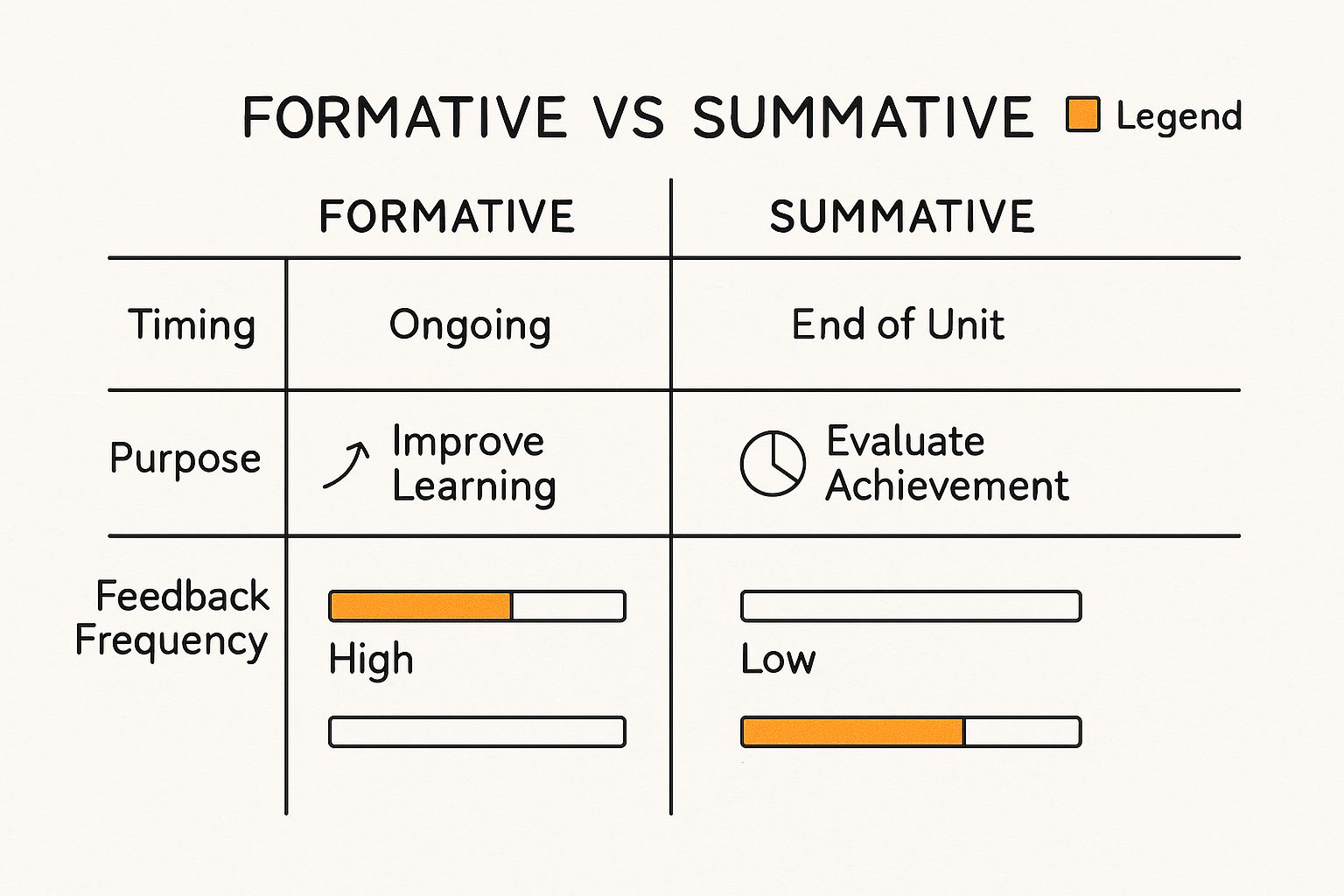
The formative approach is a continuous cycle aimed at improvement, while the summative approach is that final checkpoint for evaluation.
Summative Feedback: The Milestone Marker
While formative feedback fuels the process, summative feedback provides closure and celebrates accomplishment. This isn't about giving a grade; it's about acknowledging a finished piece of work and the effort that went into it.
This helps a child see the result of their hard work and reflect on the skills they’ve gained. It’s that moment you both step back and say, "Wow, look what you made!"
A healthy learning environment doesn't choose between formative and summative feedback; it blends them. Formative feedback builds the skills, and summative feedback celebrates the results, creating a complete cycle of making, shipping, and reflecting.
A balanced approach is key. Kids need coaching during the game and celebration after to mark the achievement. Using both ensures your child feels supported while they learn and proud of what they create.
For a quick reference, here’s a simple table breaking down the key differences.
Formative vs Summative Feedback at a Glance
This table simplifies the coach vs. audience analogy, helping you decide which type of feedback is needed.
| Characteristic | Formative Feedback (The Coach) | Summative Feedback (The Audience) |
|---|---|---|
| When It Happens | During the learning process or project. | After the project is complete. |
| Main Goal | To improve and guide the process. "How can we make this better?" | To appreciate the final outcome. "What was the result?" |
| Focus | Effort, strategies, progress, and iteration. | The final product, overall achievement, and skills learned. |
| Frequency | Ongoing and frequent. | A single event at the end. |
| Feels Like | A supportive conversation, a brainstorming session. | A moment of reflection, a celebration of accomplishment. |
| Example | "I see you're trying a new way to draw that tree. What if you...?" | "You finished your whole comic book! Let's read it together." |
Ultimately, both are essential. Formative feedback is for the messy middle, and summative feedback is for that proud finish line.
How to Use Formative Feedback Tonight
Theory is great, but the magic happens when you put formative feedback into practice. The good news? You can start tonight with a simple project that turns a spark of curiosity into a moment of agency.
The whole point is to focus on the process, not just the finished product.
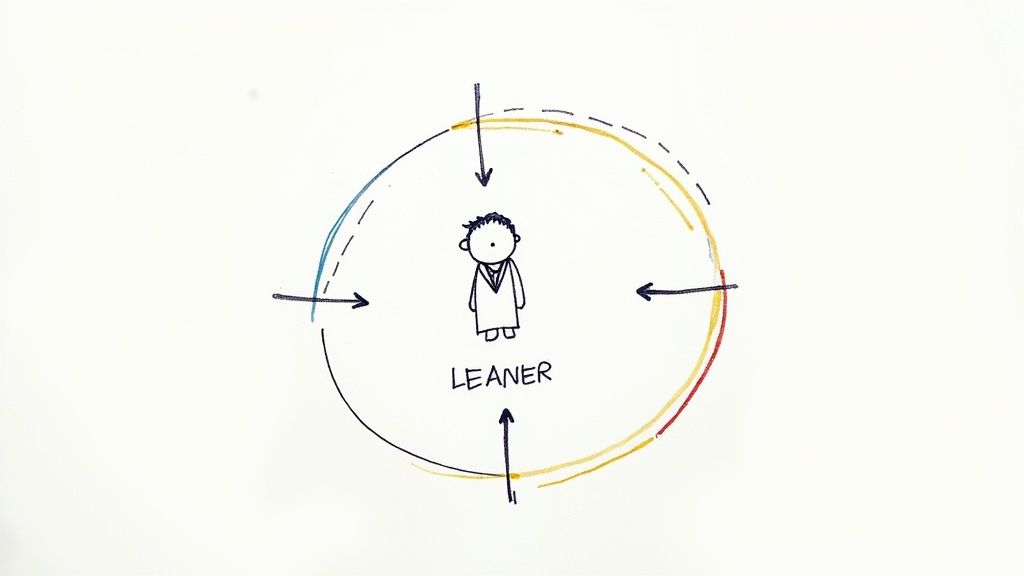
Let's try a quick project: Design a Superhero Gadget. It’s perfect because there's no single "right" answer. It’s all about creative problem-solving and gives you a low-stakes way to practice feedback that guides rather than judges.
A Simple Project, Three Ways
Here’s how you can adapt the project to fit whatever time you have, whether it’s 10 minutes or 45.
The 10-Minute Sketch (The Quick Spark)
- Time: 10 minutes
- Materials: Paper, pencil or crayon.
- No-kit option: Describe the gadget out loud! No drawing needed.
- Steps: Ask your child to quickly sketch their gadget and label its key feature.
- Feedback Script: “Tell me about your first idea. If you had five more minutes, what’s one thing you would add or change?”
The 20-Minute Prototype (Iterate and Improve)
- Time: 20 minutes
- Materials: Cardboard scraps, tape, scissors, markers.
- Safety: Adult nearby for cutting.
- No-kit option: Act out exactly how the gadget works.
- Steps: They'll start with a quick sketch (version 1), then build a simple 3D model (version 2).
- Feedback Script: “Show me v1. What changed when you started building v2?”
The 45-Minute Mission (Research and Present)
- Time: 45 minutes
- Materials: Same as above, plus a book or safe search engine.
- Safety: You supervise any online research.
- Steps: Sketch it, research one real-world technology that inspired it, build a model, and then give a 30-second “pitch” explaining how it works.
- Feedback Script: “Where did you get stuck, and how did you unstick it? I love how you explained its special power.”
Making Feedback a Conversation
Those scripts? That’s formative feedback in action. They’re open-ended questions that get your child to reflect. This approach teaches them to think like a problem-solver and builds their confidence to tackle challenges alone.
The core of great formative feedback is curiosity. By asking "how" and "what if" instead of judging the outcome, you shift the focus from getting it right to the process of learning and improving.
To make your feedback land, you can even borrow from effective audience engagement strategies. After all, your child is your most important audience.
If planning activities feels like one more thing on your plate, Kubrio can help. Start from any spark—dinosaurs, video editing, chess tactics. Kubrio drafts right-sized quests (10, 20, or 45 minutes) and guides you on what feedback to give. Finished work saves to a portfolio so growth is simple to see and share. It's a practical way to bring the difference between formative vs summative feedback to life, every day.
The Real Impact of Process-Focused Feedback
When we stop asking, “Is it right?” and start asking, “How did you get there?” something shifts. This is the power of formative feedback—it’s not just about finishing a project; it’s about building the internal wiring for grit, creativity, and a growth mindset.
Focusing on the process teaches kids that effort and iteration are the real goals. It reframes mistakes from failures into valuable data—clues for what to try next. This is how we raise self-directed learners who don’t just know answers but know how to find them.
This isn't just a warm idea; the benefits are measurable. Formative feedback has been shown to significantly boost academic performance. Foundational research shows in-process feedback leads to real improvement because it encourages kids to engage more deeply. Learn more about how student data guides these assessments.
Building Resilience One Question at a Time
Every time you ask, “What will you change in version two?” or “Show me your favorite mistake and what it taught you,” you’re coaching resilience. You are showing your child that progress is a loop of trying, testing, and tweaking—not a straight line.
This approach is an antidote to the fear of not being good enough. Instead of shying away from difficult tasks, they learn to lean into them, armed with the knowledge that the effort itself is the win. This builds their agency and gives them the tools to navigate hurdles on their own.
“I used to just say ‘that’s great!’ Now I ask my daughter what part was the hardest and what she learned. She’s so much more willing to try tough projects because she knows the goal is to learn, not just to finish.” — Sarah, a parent from Austin
From Feedback to Tangible Growth
Ultimately, the goal of formative feedback is to make growth visible. When a child can see their own progress—from a rough sketch to a polished creation—they internalize the value of perseverance. They’re building proof that they can tackle hard things.
This is where the distinction between formative vs summative feedback becomes clear. Formative feedback builds the skills, while a summative moment celebrates the final artifact. Both are valuable, but it's the process-focused conversations that forge capable, confident thinkers ready for whatever comes next.
Finding the Right Feedback Balance for Your Family
The art isn't choosing between formative and summative feedback. It's knowing when to use each one. They’re complementary tools in a powerful learning cycle.
Formative feedback is for the messy middle—the building and experimenting phases. Summative feedback is for milestone moments—celebrating a finished project.
Formative During the Process
Imagine your child is building a LEGO robot. This is prime time for formative feedback. The goal isn’t to judge the robot, but to support their thinking while they build.
Here, you get to be a curious coach. Try asking process-focused questions that spark their own problem-solving:
- “I see you tried connecting the wheels that way. What happened?”
- “What’s the trickiest part you’re working on right now?”
- “What’s one thing you might change in your next version?”
These questions don't give away answers. Instead, they reinforce that the effort and thinking are what matter most.
Summative After the Project Is Done
Now, the LEGO robot is finished, and your child is beaming. This is the moment for summative feedback. The building is over; it's time to step back and appreciate what they’ve created. For younger kids, pairing this celebration with other educational and engaging activities for toddlers can make learning feel even more rewarding.
Your role shifts from coach to an appreciative audience. This gives them a sense of closure and acknowledges their hard work.
Formative feedback is the conversation that builds the project. Summative feedback is the reflection that honors it. One fuels the journey; the other celebrates the destination.
Summative comments are about celebrating the accomplishment:
- “Wow, you finished the whole robot! Let's see what it can do.”
- “I’m impressed with how you solved that problem with the arms.”
- “Let's take a picture of this for your portfolio.”
This blend shows your child that both the process and the product are valuable. The formative check-ins build skills, while the summative celebration provides that awesome sense of pride, completing a learning loop that makes them eager for the next project.
How a Portfolio Can Tell the Real Story of Growth
Feedback lands when it tells a story of progress. A simple portfolio can make your child's learning journey visible, moving beyond the limits of just summative feedback.
You don't need a complicated system. It can be as simple as snapping a photo of a project's first draft (v1) and another of the final version (v2). Or saving a short video of them explaining their creation. These artifacts become tangible proof of their effort and how their skills grew over time.
Making Progress Something You Can See
A portfolio turns abstract ideas like "grit" into something you can point to. When a child looks back at their work, they're reminded not just of what they made, but of how they learned to make it better. It’s a powerful tool for building self-awareness. You can find more ideas for creating a standout digital portfolio for students that captures their unique talents.
For years, summative assessments were king. But we now know formative feedback has a more direct impact on learning. While over 60% of educators recognize its benefits, limited time means only about 40% use it consistently. This highlights a need for more growth-focused methods. Learn more about these educational frameworks.
Automating the Story of Their Journey
Let's be honest, keeping track of these moments can feel like another chore. This is where technology can simplify things without taking over.
The best portfolios don't just store finished work; they capture the messy, iterative journey that led to it. They are a celebration of both process and product.
Kubrio is a family-driven learning platform that uses AI to turn your child’s interests into step-by-step quests with feedback and a living portfolio. As your child works on projects, the platform automatically saves their work, creating a visual timeline of their growth that you can both reflect on and share.
This blend of ongoing formative feedback and summative moments tells a richer story—the story of your child’s developing agency.
Common Questions About Giving Feedback at Home
Putting this into practice at home can feel a little awkward. Here are a few common questions from parents, with simple answers.
How do I give formative feedback without it feeling like criticism?
The secret is to shift from being a judge to a curious co-pilot. Frame your feedback as a collaborative puzzle you're solving together. This turns you from a critic into a supportive coach.
Use open-ended questions that get your child thinking:
- "What's your plan for the next step?" This looks forward, not backward.
- "Show me the part you're most proud of so far." Starting with a positive anchor changes the tone.
- "That's an interesting way to do it. What gave you that idea?" This honors their thought process.
Is summative feedback ever useful at home?
Absolutely. Summative feedback is for celebrating. It’s perfect for marking milestones and giving your child a satisfying sense of closure. Once a project is done, you can both step back and appreciate it.
Think of it as the victory lap. Use it to wrap up an activity, point out the skills they used, and add the final work to their portfolio. It’s that "Wow, look what you made!" moment that validates their hard work.
I only have 15 minutes—can I still use formative feedback?
Yes. Some of the best formative feedback happens in quick, fly-by moments. The goal isn't a long review; it's about frequent, small check-ins that nudge their thinking.
Just ask one good question while they’re in the middle of their work. Something like, “What’s one thing you might change if you did this again?” or “Where did you get stuck, and how did you get unstuck?” This builds their self-reflection muscles in real-time.
These quick chats are a fantastic way to teach problem-solving skills without needing to block out an hour. It shows your child that learning is a continuous process made of small, everyday steps.