
How to Teach Problem Solving Skills: A Guide for Future-Ready Parents
To teach problem-solving, you have to reframe your role. Stop being the answer-provider. Become the thinking-coach.
It’s a subtle but powerful shift. Instead of handing over solutions, your job is to guide your child through their own process of exploration and discovery. This is how they build the mental muscles to tackle challenges independently, turning frustration into accomplishment.
Why Problem-Solving Is a Child's Real-Life Superpower
Picture this: your child is staring at a half-finished LEGO creation, totally stuck. Frustration is building. Your instinct is to jump in and fix it for them.
But what if, instead, you said, "That looks tricky. What have you tried so far?"
That one question is the first step in teaching a fundamental superpower for navigating life: problem-solving.
Our world often rewards kids for memorizing facts, but true adaptability comes from knowing how to think, not just what to think. Problem-solving isn't another subject to check off a list. It’s the mental framework kids use for everything—from figuring out a disagreement with a friend to tackling a complex science project. It’s a process for finding their own way forward.
From Rote Learning to Resilient Thinking
Traditional schoolwork often boils down to finding the one right answer. Problem-solving is the opposite. It’s about exploring different paths and learning from the ones that lead to a dead end.
It’s messy, creative, and incredibly empowering. By nurturing this skill, you’re giving your child tools they’ll use forever:
- Resilience: They learn that mistakes aren't failures—they're just information.
- Confidence: Every single solution they discover on their own builds their belief in their own abilities.
- Adaptability: They build the mental flexibility to face brand-new challenges in a future we can’t even predict.
Strong problem-solving is deeply connected to our cognitive wiring, and understanding executive function helps explain why it's such a crucial skill for kids. The data shows we have a lot of work to do. The 2012 PISA assessment revealed that only about 11% of 15-year-olds in OECD countries are top performers in individual problem-solving. These are the students who can systematically explore a complex issue, adjust their plan based on feedback, and create multi-step solutions.
The goal isn't to raise a child who has all the answers. The goal is to raise a child who isn't afraid to find them.
This guide provides practical, real-world strategies to help you cultivate this essential superpower. You can learn more about the core components of problem-solving skills and see how you can start building this foundation today.
Cultivating a Problem-Solving Mindset at Home

The most powerful learning happens when kids feel safe enough to explore, mess up, and try again. Your home is the ultimate training ground for this, and your role is to pivot from being the "family fixer" to the "thinking coach."
It's a natural instinct to swoop in and solve problems for our kids. But every time we jump in with a ready-made solution, we rob them of an opportunity to build their own problem-solving muscles. The real goal is to create a home where curiosity, not panic, is the first response to a challenge.
Shift Your Language to Encourage Thinking
The words we choose can either shut down a child's thinking process or open it wide. Resisting the urge to just give them the answer is the secret. Replacing it with guiding questions is what truly teaches them how to think.
Instead of jumping in with, "Here, let me do it," try one of these coaching phrases:
- "Wow, that’s a tricky one. What's a tiny first step we could try?"
- "What have you already thought of?"
- "That's interesting! What do you think would happen if we tried it this way?"
- "Tell me more about what's not working."
These questions send a powerful message: "I have faith in you to figure this out." They show that wrestling with a problem is more important than getting the right answer instantly.
Your job isn't to clear the path for your child, but to give them the tools to navigate any path they encounter. This starts by modeling curiosity when things get messy.
Model a Growth Mindset During Everyday Hurdles
Your kids are always watching. How you handle minor, everyday frustrations sets the template for how they’ll approach their own. A broken toy, a missing ingredient for dinner, or a tangled shoelace aren't just annoyances—they're live-action problem-solving workshops.
The next time you hit a small snag, narrate your thought process out loud.
"Oops, we're out of eggs for these cookies. Hmmm, what else could we use? I wonder if applesauce would work. Let's look it up and see."
This simple act shows them that problems are a normal, solvable part of life. It demonstrates a calm and strategic approach instead of a frustrated or defeated one.
Praise the Process, Not Just the Outcome
To build resilience, you must shift praise away from the final result and focus it squarely on the effort, strategies, and persistence your child shows. When we praise the process, we reinforce the behaviors that lead to sustainable success.
Here’s a quick guide to reframing your feedback:
| Instead of Praising the Outcome... | Try Praising the Process... |
|---|---|
| "You're so smart!" | "I love how you kept trying different ideas until one clicked. That was amazing!" |
| "See, you got it right!" | "You were so patient with that tough puzzle. Your focus was incredible." |
| "That's the perfect answer." | "The way you broke that huge problem into smaller pieces was a really clever move." |
This kind of feedback teaches children that their effort and their thinking are what truly matter. It’s how we build the grit they need to tackle not just today’s homework, but all of life’s bigger challenges.
A Simple Framework Kids Can Use for Any Problem
When a problem feels big and messy, kids often shut down. They don't know where to start. Giving them a structured way to think—not a rigid script, but a flexible mental map—can make all the difference.
This empowers them to break down any challenge, from a playground squabble to a tough school project, into manageable pieces.
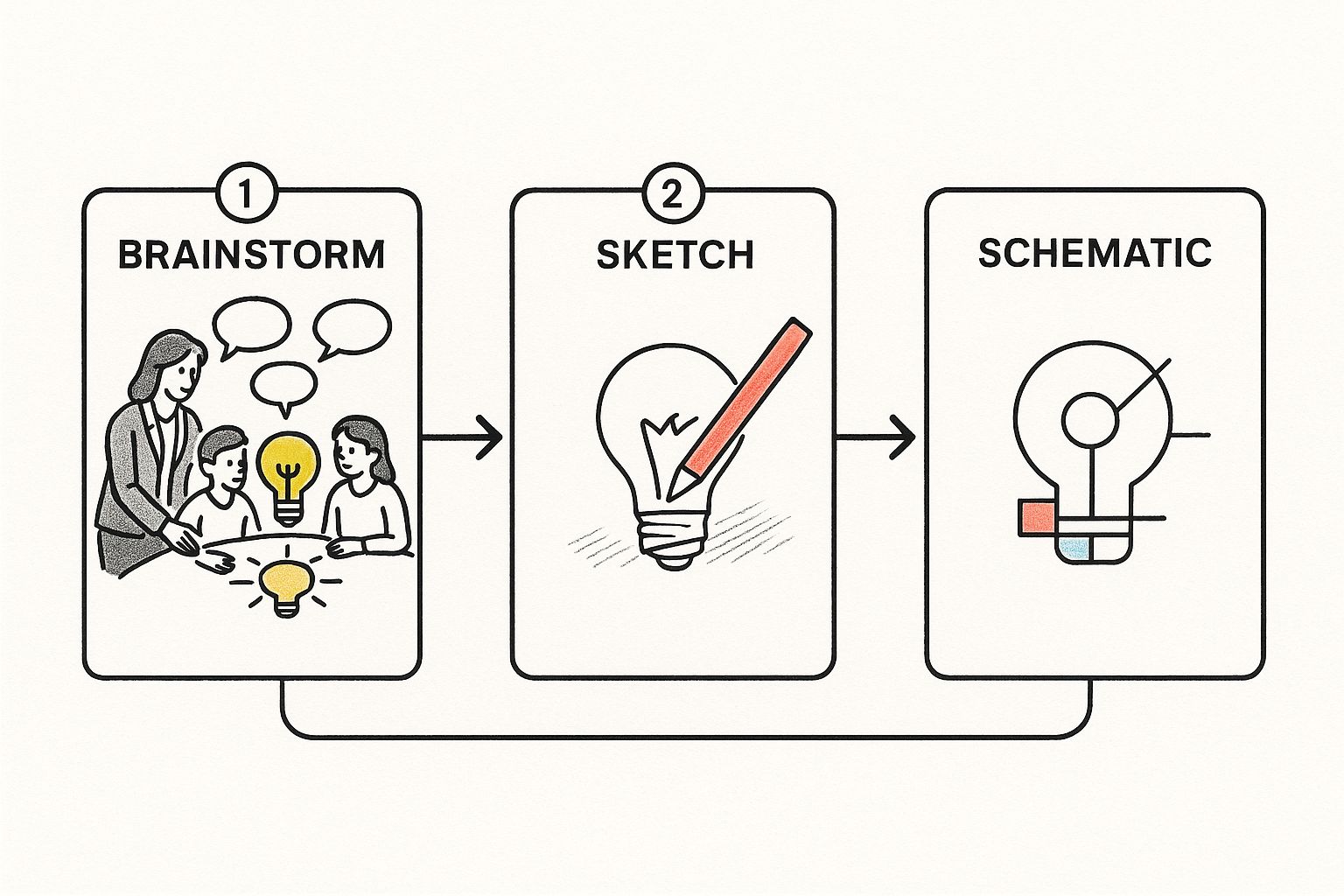
The goal isn't a complex flowchart. Instead, we can introduce a simple, four-part framework using language they'll understand. This teaches a reliable sequence for thinking critically and creatively.
The Four Core Steps
This process boils down to four intuitive actions. The magic happens when these steps become a natural part of your child’s thinking.
-
Figure Out the Goal: What are we really trying to do here? This is about defining the problem. Help them get clear on the desired outcome in the simplest terms.
-
Gather Your Clues: What do we already know? This is the detective phase. Encourage them to collect information, observe what’s going on, and identify the key facts.
-
Dream Up Ideas: What are all the different ways we could try? This is where creativity runs wild. The only rule? No bad ideas. Brainstorm every possible solution, no matter how silly it sounds.
-
Test It Out: Let's pick one idea and see what happens. This final step is about taking action and learning from the result. If it doesn't work, no big deal. They go back to their list of ideas and try another one.
This isn’t a one-and-done formula; it's a loop. The "Test It Out" phase provides new "clues," which helps refine the goal and spark new ideas. This iterative process is the heart of effective problem-solving.
Applying the Problem-Solving Framework to Everyday Challenges
The true power of this framework is its adaptability. The language and depth can change based on your child's age and the challenge they're facing. You become the coach, guiding them with questions that fit the situation.
Let's see how this works with some common childhood challenges.
| Problem-Solving Step | Scenario 1 Disagreement with a Friend (Ages 6-9) | Scenario 2 Difficult School Project (Ages 10-13) |
|---|---|---|
| Figure Out the Goal | "What do you want to happen so you can both feel happy and play together again?" | "What does the finished project need to have to get a good grade? Let's check the instructions." |
| Gather Your Clues | "Why do you think your friend is upset? What happened right before the argument started?" | "What are the main topics we need to cover? Where can we find reliable information for each part?" |
| Dream Up Ideas | "What are three things you could say? Maybe apologize, suggest a new game, or take a break?" | "How could we present this? A slideshow, a poster, a video? Let's list the pros and cons of each." |
| Test It Out | "Let's try saying you're sorry first and see how your friend responds. We can try something else if that doesn't work." | "Let's start by creating a quick outline for the slideshow. We can always change it if we get a better idea." |
The core logic stays the same, but the conversation changes.
By consistently using this simple language, you’re installing a powerful mental operating system. You are teaching your child not just how to solve a single problem, but how to become a lifelong problem solver.
This framework gives them the confidence to face uncertainty, knowing they have a reliable process to fall back on every single time.
Fun Activities That Build Problem Solving Muscles
Talking about problem-solving is one thing, but real growth happens when kids get to roll up their sleeves and actually do it. The best way to build these mental muscles is through play.
The goal is to create dynamic challenges that make kids think on their feet, work with others, and pivot when things don't go as planned. These activities turn playtime into powerful learning moments.
Collaborative Storytelling
This one requires zero setup—just imagination.
Start a story with an intriguing sentence. "A tiny robot with grasshopper legs found a key that didn't fit any lock." Your child adds the next sentence. You go back and forth, building the narrative together.
The problem-solving kicks in when you introduce a challenge. If you add, "But just as the robot was about to give up, the key started to hum," your child has to figure out what happens next. It's a fantastic way to practice:
- Creative Thinking: They have to dream up new ideas on the spot.
- Sequential Logic: They learn that every action has a consequence in the story.
- Adaptability: They can't plan ahead; they have to react to whatever twist you throw in.
DIY Escape Room Challenges
You can create an amazing escape room experience in your living room. A simple scavenger hunt with a series of connected clues works wonders.
Start with a clear goal, like "Find the secret ingredients for tonight's pizza."
Each clue should lead to the next, but make them solve a different kind of puzzle each time. One clue could be a riddle (logical reasoning), another might require them to build a small Lego tower to reach something on a shelf (spatial awareness), and the next could be a simple coded message (pattern recognition). It’s a brilliant exercise in strategic thinking and perseverance.
The best challenges have a "low floor and a high ceiling." That means they're easy to get started with but can become as complex as you want. Building a blanket fort can easily turn into an engineering project with just a few encouraging questions.
Open-Ended Building Challenges
Grab a box and fill it with random stuff—cardboard tubes, tape, rubber bands, plastic cups. Then, give your child a simple mission.
- "Build a machine that can launch a cotton ball across the table."
- "Create a bridge that can hold the weight of your favorite toy car."
- "Design a contraption to protect an egg from a one-foot drop."
There's no single "right" way to do it. These challenges are all about experimentation. They force kids to try an idea, see if it works, and learn from their failures. It’s a perfect, small-scale version of how real-world innovation happens.
This process is at the heart of many modern problem-solving methods. You can see similar principles in action by exploring the fundamentals of design thinking for kids, which encourages empathy and building prototypes to solve problems for others.
By making it all about play, you create a safe space where trying and failing is just part of the fun. These aren't just activities to pass the time; they are hands-on practice that turns abstract ideas into real, lifelong skills.
Navigating Modern Problems in a Digital World

Today's playgrounds are as likely to be digital as they are physical, and the problems our kids face online are as real as a scraped knee. From spotting fake news to navigating a tricky group chat, these challenges demand a new set of problem-solving muscles.
Handing a child a device without teaching them how to think critically about the world it unlocks is like giving them a library card without teaching them how to read. The goal isn't just to raise kids who can use technology, but to raise digitally savvy kids who are confident, critical thinkers.
From Tech User to Tech Thinker
The first step is to show kids that technology is a tool they control, not the other way around. This can start with troubleshooting everyday tech glitches together.
Instead of swooping in to fix a frozen app yourself, try asking, "Hmm, that's stuck. What do you think we should try first?" This small shift empowers them to see tech issues as solvable puzzles rather than frustrating dead ends.
Another huge piece is information literacy. The internet is flooded with information, and not all of it is credible. You can build this skill by turning it into a game.
- Become Co-Detectives: When you look up a new topic together, ask questions. "Who made this website? What do you think their goal is? Can we find this same information somewhere else to double-check?"
- Teach Smart Searching: Show them how using different keywords changes the results. Make it clear that the first result isn't automatically the best one.
The data shows just how badly these skills are needed. A multi-year OECD survey revealed that only 36% of adults in the United States could perform at a proficient level in digital problem-solving. That puts the U.S. behind countries like Japan (56%) and Finland (51%). You can dive into the technology-rich problem-solving skill findings yourself—it's an eye-opener and makes the case for starting this young.
Role-Playing Digital Dilemmas
Social problems online can feel abstract and overwhelming. Role-playing is a powerful, low-stakes way to prepare them for situations they’ll almost certainly encounter.
Try setting up simple scenarios and talk through the options. "What would you do if a friend said something mean in a group chat?" or "What if someone you don't know asks to be your friend online?"
Discussing these situations calmly at the dinner table builds a mental playbook they can draw from when emotions are running high. It equips them with strategies before they ever need them.
Giving children tools to manage their digital lives is another powerful form of problem-solving. Exploring how digital planning strategies for productivity can help them organize homework and juggle online activities is an incredibly practical way to navigate modern complexities. By doing this, you're not just teaching them to solve isolated problems; you're building a foundation of digital competence that will serve them for a lifetime.
Your Questions on Teaching Problem Solving Answered
Even with the best game plan, teaching kids to solve their own problems can feel like walking a tightrope. You're going to hit moments of frustration (theirs and yours), resistance, and probably some self-doubt.
Knowing how to navigate these common bumps is what separates a good effort from a great outcome. Here’s a look at the questions I hear most often from parents making the switch from "family fixer" to "thinking coach."
What if My Child Gets Frustrated and Wants to Quit?
This is the most common hurdle. That moment when a kid throws their hands up and says, "I'm done!" is a sign you're on the right track. It means the challenge is hitting that sweet spot—it's tough enough to make them grow, but not impossible.
First, validate the feeling. Don’t dismiss it. Try saying, “I can see this is really getting to you. It’s okay to feel frustrated when things are this tricky.” Acknowledging their struggle can take the pressure down a notch.
Then, gently steer them back to the process, not the answer. Ask, “What’s the absolute smallest thing we could try next?” or suggest, “Let’s hit pause. We can grab a snack and come back with fresh eyes in ten minutes.” The goal isn’t to get rid of the struggle, but to show them how to work through it.
How Do I Balance Guiding Them vs. Letting Them Struggle?
This is the million-dollar question. Finding that balance takes time and intuition. My go-to strategy here is the “Ask, Don’t Tell” approach. Instead of handing them solutions, you only offer questions that get their own gears turning.
- When they're stuck: "What have you already tried?"
- When they're about to make a mistake: "Interesting idea. What do you think might happen if you do that?"
- When they get it right: "Awesome, that worked! Why do you think it did the trick?"
This shift keeps the mental heavy lifting on their shoulders. Think of yourself as the coach on the sidelines—you’re there for support, not to jump on the field and score the goal for them. You provide just enough scaffolding to prevent a total meltdown, but not so much that they never build their own strength.
How Can I Adapt This for Different Personalities?
Problem-solving isn't one-size-fits-all. The way you support a cautious kid will look very different from how you help a child who dives in without a second thought.
- For the cautious child: Your praise should focus on their willingness to even try, no matter what happens. Frame mistakes as "collecting clues" about what doesn't work. It’s all just data.
- For the impulsive child: Gently encourage them to pause and "gather their clues" before they leap. You might ask them to talk through their plan out loud before they start.
Ultimately, it all comes back to showing them that their abilities aren’t fixed—they can grow with effort and smart strategies. Exploring different growth mindset activities for kids can give you fantastic, practical ideas for tailoring this to your child’s unique style. When you focus on effort and strategy over just getting it "right," every kid can start to see themselves as a truly capable problem solver.