
10 Problem Solving Games for Kids to Build Real-World Skills
In a world shaped by AI, your child's ability to tackle new challenges is their most important skill. But many educational tools fall into a familiar trap: passive, one-size-fits-all "learning" apps that quiz kids on facts but fail to build genuine competence. This guide is different. It’s a curated collection of powerful problem solving games for kids designed to move beyond worksheets and cultivate true agency.
Here, we aren't just listing activities. We’re providing a practical framework for turning playtime into a portfolio of real skills. Each game is a launchpad for your child to make, test, and reflect. To build a problem-solver and not just a quiz-taker, it's essential to improve problem solving skills at their core.
This list offers specific, tonight-ready ways to do just that. You’ll find age-appropriate challenges and reflection prompts that help your child see their own growth. Our goal is to equip you with the tools to foster a confident, high-agency learner who sees every problem not as a barrier, but as an opportunity.
1. Coding & Logic Puzzles (Block-Based Programming)
Block-based programming environments are fantastic problem solving games for kids that teach the fundamentals of coding without complex syntax. Children snap together colorful, instruction-filled blocks to build scripts—like digital LEGOs. This visual approach allows them to create animations, stories, and simple games, making abstract concepts like sequences, loops, and conditional logic tangible.
This method empowers kids to think like engineers. They learn to break down large problems into smaller steps, test their solutions, and debug errors. It’s a powerful way to build resilience and analytical skills that apply far beyond the screen.
How to Get Started
- Time: 20-45 min • Materials: Computer or tablet • Output: A working animation or mini-game.
- Skills Developed: Algorithmic thinking, systematic reasoning, debugging, creativity.
- Platforms to Try: Start with Scratch from MIT, explore guided courses on Code.org, or try Google's Blockly Games.
- Reflection: What changed between your first idea and the final code? Where did you get stuck and how did you unstick it?
- Kubrio in this context: If your child loves building game levels in Scratch, Kubrio can draft right-sized quests (10, 20, or 45 minutes) to design, build, and share a complete multi-level game.
2. Escape Room Puzzles & Logic Challenges
Escape room games, whether physical kits or digital adventures, are powerful problem solving games for kids. They drop players into a story-driven scenario where they must solve interconnected puzzles against a time limit to "escape." This format transforms abstract logic into a thrilling adventure, demanding pattern recognition, lateral thinking, and collaboration.
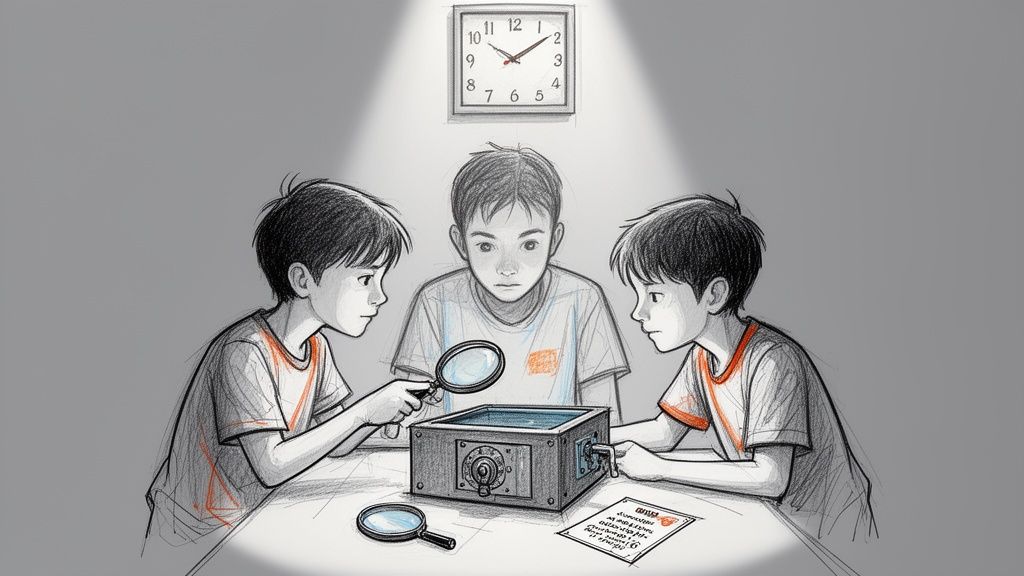
These challenges are a direct antidote to passive learning. Instead of just absorbing information, kids must apply it, make connections between seemingly unrelated clues, and manage resources like time under pressure. It's an excellent way to see how individual skills combine to conquer a larger problem.
How to Get Started
- Time: 45 min • Materials: At-home kit or a digital platform • Output: A solved puzzle sequence.
- Skills Developed: Deductive reasoning, collaborative communication, critical thinking.
- Platforms to Try: Look for at-home kits from ThinkFun, explore digital puzzles with Breakout EDU, or try a family-friendly physical escape room.
- Reflection: Which puzzle was the hardest, and what strategy finally worked? What was the most important decision we made as a team?
- Kubrio in this context: Use these problem-solving activities for elementary students as inspiration. Kubrio is a family-driven learning platform that uses AI to turn your child’s interests into step-by-step quests with feedback and a living portfolio.
3. LEGO Engineering & Building Challenges
Hands-on construction with LEGO bricks is one of the most effective problem solving games for kids, translating abstract ideas into tangible results. These challenges task children with building structures or machines under specific constraints, like a limited number of pieces or a functional goal. This process blends spatial reasoning with core engineering principles.
By tackling a design brief, kids learn to plan, test theories, and adapt when things don't work. This build-test-rebuild cycle normalizes failure as a productive part of the problem-solving process, building resilience and a growth mindset. They are learning to think like engineers.
How to Get Started
- Time: 20 min • Materials: LEGO bricks • Output: A structure that meets a specific challenge (e.g., holds a book).
- Skills Developed: Spatial reasoning, iterative design (v1→v2), resource management.
- Platforms to Try: Start with basic LEGOs, or explore robotics with LEGO Education SPIKE or FIRST LEGO League.
- Reflection: Show me v1. What will you change in v2? What part didn't work as you expected?
- Parent Praise: “I love how you changed your plan after testing that first design.”
4. Riddles, Brain Teasers & Logic Games
Verbal and written puzzles are classic problem solving games for kids that build mental agility. From riddles to brain teasers, these short challenges teach children to approach problems from unexpected angles and think beyond the obvious solution. They are excellent for developing quick, flexible reasoning without needing screens or extensive setup.
These games strengthen a child's ability to analyze information and make logical deductions. Instead of following a linear path, kids learn to re-examine assumptions and interpret language creatively. This skill is invaluable for tackling complex problems in school and life.
How to Get Started
- Time: 10 min • Materials: Book, app, or just your voice • Output: A solved riddle or puzzle.
- Skills Developed: Lateral thinking, pattern recognition, deductive reasoning.
- Platforms to Try: Explore puzzles from authors like Martin Gardner or engage with platforms like Brilliant.org for interactive logic challenges.
- Reflection: What was the trick in that riddle? What was the first idea you had, and why didn't it work?
- Kubrio in this context: If your child enjoys making up their own riddles, the Kubrio generator can create a quest where they design, write, and illustrate a themed riddle book to share.
5. Design Thinking & Prototyping Challenges
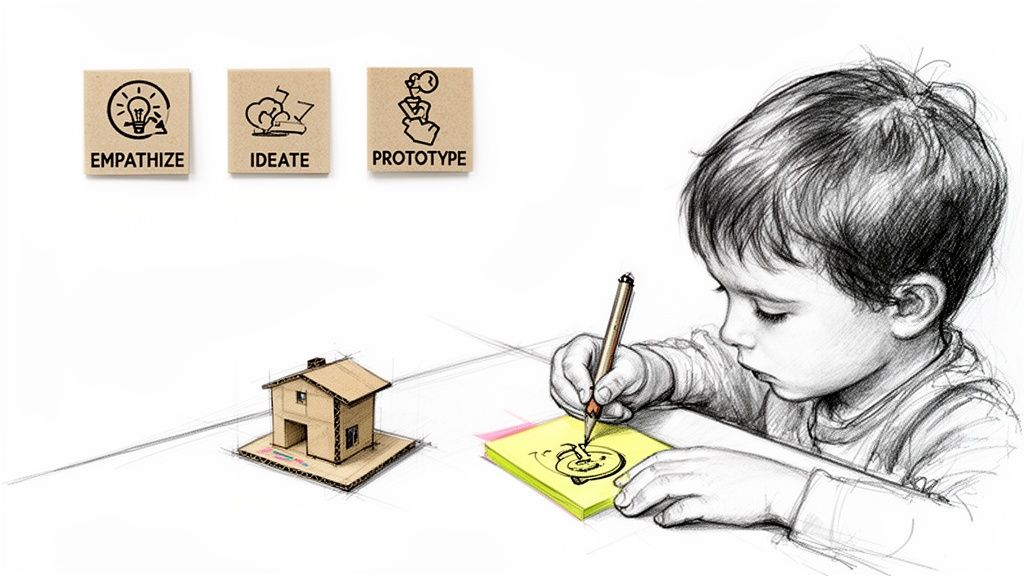
Design Thinking introduces kids to a powerful, empathy-driven method for solving real-world problems. Instead of just finding an answer, the process encourages them to understand a user’s needs first, then brainstorm, build, and test solutions. It’s a structured approach to innovation framed as a fun and accessible problem solving game for kids.
This method shifts the focus from "being right" to "learning and improving." Children learn to embrace feedback and see failure as a vital part of the process. By building simple prototypes out of everyday materials, they make their ideas tangible and test assumptions quickly.
How to Get Started
- Time: 45 min • Materials: Cardboard, tape, markers • Output: A v1 prototype that solves a household problem.
- Skills Developed: Empathy, creative confidence, systems thinking, iteration.
- Platforms to Try: Explore frameworks from Stanford’s d.school or join the student movement at Design For Change.
- Reflection: What did you learn from testing your first prototype? What one thing will you change for the next version?
- Parent Praise: “Show me your favorite mistake and what it taught you.”
6. Strategy Board Games & Game Theory
Strategy board games are exceptional problem solving games for kids, teaching them to think several steps ahead and manage resources. Unlike games of pure chance, these require players to make calculated decisions and anticipate opponents' moves. From Chess to modern classics, players learn probability and long-term planning in a fun, social setting.
This type of play turns abstract concepts into tangible outcomes. A child learns that sacrificing a piece now might lead to a win later, or that building a settlement affects everyone's resources. They develop the ability to analyze a complex system, formulate a plan, and adjust it on the fly.
How to Get Started
- Time: 20-45 min • Materials: A board game • Output: A completed game with a clear winner or shared goal.
- Skills Developed: Strategic thinking, forward planning, risk assessment, adaptability.
- Platforms to Try: Start with Chess (try ChessKid), move to gateway strategy games like Ticket to Ride, or try cooperative games like Pandemic.
- Reflection: What decision mattered most in that game? What would you try differently next time?
- Parent Praise: "That was a clever move. I didn't see it coming."
7. Storytelling & Narrative Design Challenges
Storytelling is one of the most powerful problem solving games for kids because it teaches them to structure complex ideas. Through creative writing challenges with specific constraints, children learn to build logical narratives, develop compelling characters, and sequence events to create a cohesive plot. It's about organizing thoughts and communicating them effectively.
These exercises build narrative logic and the ability to manage intricate systems of information. By working within limits, such as a word count, kids practice creative thinking under pressure, transforming abstract ideas into tangible, shareable creations.
How to Get Started
- Time: 20 min • Materials: Paper and pencil or a notes app • Output: A short story with a beginning, middle, and end.
- Skills Developed: Creative thinking, sequencing, communication, empathy.
- Platforms to Try: Explore youth programs from NaNoWriMo or record family histories with StoryCorps.
- Reflection: Which step took the most effort, and what would you try next time? What changed between your first draft and the final story?
- Kubrio in this context: Start from any spark—dinosaurs, video editing, chess tactics. Kubrio drafts right-sized quests (10, 20, or 45 minutes) and guides you on what feedback to give.
8. Math Problem-Solving & Competition Math
Moving beyond rote memorization, competition math teaches kids to approach numbers as a creative puzzle. These programs focus on logic and number theory, framing complex challenges as engaging problems to solve. It’s a powerful shift from "what's the answer?" to "how many ways can we find the answer?"
This method builds mathematical reasoning and resilience. Children learn to tackle multi-step problems and explore unconventional strategies. By framing math as a creative endeavor, programs like Math Kangaroo or Beast Academy make advanced concepts accessible and fun, turning potential math anxiety into curiosity.
How to Get Started
- Time: 20 min • Materials: A puzzle book or online platform • Output: A solved logic puzzle with the steps shown.
- Skills Developed: Logical reasoning, strategic thinking, perseverance.
- Platforms to Try: Explore the graphic novel approach of Beast Academy, the international challenges of Math Kangaroo, or the curriculum of Art of Problem Solving (AoPS).
- Reflection: What was a cool way to start? What would you try differently next time?
- Parent Praise: "I love how you didn't give up when that first strategy didn't work."
9. Maker Projects & Engineering Design
Maker projects are hands-on engineering challenges where kids build functional devices. From simple circuits to complex animatronics, these activities transform children from consumers into creators. This approach mirrors the real engineering design process, encouraging experimentation, tinkering, and learning from trial and error.
This tangible form of problem-solving teaches kids how systems work. They learn to follow schematics, troubleshoot faulty connections, and iterate on their designs to improve functionality. It’s a powerful method for developing resilience, making it one of the most effective problem solving games for kids who love to build.
How to Get Started
- Time: 45 min • Materials: Electronics kit or recycled materials • Output: A working circuit or simple machine.
- Skills Developed: Systems thinking, electronics, perseverance, diagnostic reasoning.
- Platforms to Try: Explore kits from Adafruit or beginner projects using Arduino. For kids interested in advanced projects, learning how to make a game app is an exciting challenge.
- Reflection: What did we learn from the design that didn't work? What will we change for the next version?
- Safety: Adult nearby for cutting or electronics. No-kit option: draw a detailed plan for the machine instead of building it.
10. Collaborative Problem-Solving Games & Team Challenges
Most real-world problems aren't solved alone. Collaborative games teach kids the vital skills of communication, negotiation, and collective strategy. In these activities, the goal is shared, forcing players to work together, assign roles, and combine their strengths to succeed.
These team-based challenges are powerful problem solving games for kids because they model real-world project dynamics. Children must listen to others' ideas, articulate their own, and navigate disagreements constructively. This process builds interpersonal intelligence and shows them how to contribute effectively to a group effort.
How to Get Started
- Time: 20-45 min • Materials: A cooperative board game or household items for a challenge • Output: A shared goal achieved.
- Skills Developed: Communication, teamwork, negotiation, role-based strategy.
- Platforms to Try: Start with cooperative board games like Forbidden Island, try local escape rooms for families, or set up team-building challenges like the "River Crossing" puzzle.
- Reflection: What strategy worked best for our team? How did we communicate when we disagreed?
- Kubrio in this context: If you like project-based learning but want it doable at home, Kubrio handles the planning and feedback so you can focus on building and reflecting together.
Quick Guide to Kids' Problem-Solving Games
| Activity | Time Needed | Materials | Key Skill |
|---|---|---|---|
| 1. Coding & Logic Puzzles | 20-45 min | Computer/Tablet | Algorithmic Thinking |
| 2. Escape Room Puzzles | 45 min | Kit or Digital Platform | Deductive Reasoning |
| 3. LEGO Engineering | 20 min+ | LEGO Bricks | Iterative Design (v1→v2) |
| 4. Riddles & Brain Teasers | 10 min | Voice or Book/App | Lateral Thinking |
| 5. Design Thinking Challenges | 45 min | Craft Materials | Empathy & Prototyping |
| 6. Strategy Board Games | 20-45 min | Board Game | Strategic Planning |
| 7. Storytelling Challenges | 20 min | Paper & Pencil | Sequencing & Communication |
| 8. Math Problem-Solving | 20 min | Puzzle Book/Platform | Logical Reasoning |
| 9. Maker & Engineering Projects | 45 min+ | Electronics Kit/Recycled | Systems Thinking |
| 10. Collaborative Games | 20-45 min | Cooperative Game | Teamwork & Negotiation |
FAQ
-
How do you explain problem-solving to a child? A: Explain it as being a "detective for solutions." A problem is like a locked door. A problem-solver tries different keys (ideas) until they find the one that works. The goal isn't just opening the door, but learning which keys work best for different locks.
-
What are some problem-solving skills for 7-year-olds? A: For this age, focus on breaking down a task into small steps (like building a LEGO set), trying a different approach when the first one fails (resilience), and asking for help after trying first (collaboration). Simple puzzles and building challenges are great.
-
How can I make problem-solving fun? A: Frame it as a game or a mission. Use a timer to add excitement, work together on a collaborative challenge, or turn the problem into a story. Celebrating the process and the "aha!" moments, not just the final answer, keeps it engaging.
From Game to Growth: Turning Play into a Portfolio
The journey through these problem solving games for kids shows a powerful truth: play is the engine of learning. From coding puzzles to LEGO engineering, each activity is a workshop for building resilience, creativity, and critical thinking. We’ve moved beyond the passive model of worksheets and quizzes to explore how hands-on challenges give children the agency to tackle problems.
The real magic happens after the game. The value isn't just in solving the puzzle but in understanding how it was solved. This is where reflection transforms a fun afternoon into a permanent skill.
Your Action Plan: Cementing the Learning
To ensure these skills stick, focus on capturing the process, not just the final product.
- Document the Work: Take a photo of the LEGO creation, record a short video of the code running, or write a one-sentence summary of the winning strategy. These small actions create tangible artifacts of their thinking.
- Ask Strategic Questions: Move beyond "Good job!" and use specific prompts. Try, "What was the hardest part, and how did you get past it?" or "If you built this again, what one thing would you change?" This builds metacognition—the skill of thinking about thinking.
- Start a Simple Portfolio: A shared digital folder or a physical binder can become a "progress journal." Finished work saves to a portfolio so growth is simple to see and share. This visual proof is a powerful confidence booster.
By creating a home environment that values process over perfection and reflection over reward, you are equipping your child with the most durable toolkit for the future. You are helping them become resourceful, independent thinkers who see the world not as a series of tests, but as a fascinating set of problems to be solved.