
Beyond "Hey, Robot": A Parent's Guide to Prompt Engineering for Kids
You’ve seen it happen. Your child, full of brilliant curiosity, asks a smart speaker a question and gets back a bizarre, unhelpful, or just plain boring answer. The spark fizzles out. What if you could give them the key to unlock technology’s creative power, turning frustrating moments into "aha!" breakthroughs?
This is where prompt engineering comes in. At its heart, it’s about teaching your child how to "speak AI." Think of it as a new kind of literacy, just as vital as reading and writing, that helps them have a meaningful conversation with tools like ChatGPT. It’s not just about getting better answers—it’s about nurturing a mindset of precision, creativity, and confident problem-solving.
This guide will give you practical strategies to help your child master this skill, transforming them from a passive user of technology into an active, high-agency creator.
Why Prompting Is the New Digital Literacy
So, what is prompt engineering? It’s simply the art of asking questions in a way that guides an AI to give you exactly what you need. By learning to add detail, rephrase, and provide context, your child builds clarity, sparks their own curiosity, and gains a ton of confidence.
The goal isn't just to get better answers from a robot. It’s about nurturing real-world skills:
- Critical Thinking: They learn that the words they choose matter. Precision leads to better results.
- Creativity: They get to experiment with wild "what if" scenarios and see what the AI comes up with.
- Digital Fluency: This skill is a massive advantage for school projects, research, and whatever comes next.
As a parent, you’re not a teacher in the traditional sense—you’re more of a co-designer. You get to watch how their minds work as they tweak their wording and see the AI's response change.
Guiding your child through these little adjustments turns frustrating mistakes into exciting "aha!" moments. It’s learning, disguised as play.
Your Role as a Guide
Your job is to nurture their natural curiosity. You don't need to be an expert yourself; you just need to be encouraging.
- Parent Coaching Language: Model curiosity by asking, "I wonder what would happen if we asked it to..."
- Celebrate the small wins and the weird results just as much as the perfect ones. It’s all part of the process.
Connecting to Everyday Learning
You don't always need a screen to practice this. Prompting is a way of thinking you can weave into your daily routine.
Turn car rides, cooking dinner, or bedtime stories into mini-adventures in asking better questions. Ask them to be super specific about what they want to know. Every conversation is a chance to sharpen these skills.
- Transform their "what if" questions into fun research quests.
- Use AI prompts to dig deeper into their favorite hobbies or characters.
Key Benefits for Young Learners
When kids see that their clear instructions get great results, something clicks.
They start to understand that they can shape the outcome, which builds incredible confidence. They also learn to solve problems by tweaking and refining their approach—a skill that will serve them well in everything from writing essays to conducting science experiments.
If you want to dig deeper into the fundamentals, this article explains what prompt engineering is and why it's quickly becoming a must-have skill.
This isn't just a niche hobby. The global prompt engineering market is projected to explode from USD 505 billion in 2025 to an incredible USD 6.5 trillion by 2034. According to Precedence Research, that’s a compound annual growth rate of 32.9% as every industry—from education to healthcare—races to adopt AI.
To make this tangible, let's look at how these abstract skills translate into real-world abilities for your child.
Prompt Engineering Skills and Their Real-World Impact
This table breaks down the core concepts into simple skills and shows their direct benefits for your child’s development.
| Core Skill | What It Means for Your Child | Future-Ready Benefit |
|---|---|---|
| Clarity in Query | Teaches precise phrasing to get clear, direct responses. | Enables them to find information efficiently in school and future jobs. |
| Context Building | Learns to add background details so the AI offers relevant answers. | Prepares them for complex tasks like technical writing and research. |
| Iterative Testing | Refines outcomes through trial-and-error and analyzing feedback. | Cultivates resilience, patience, and strong analytical thinking skills. |
These aren't just "AI skills"; they are life skills that encourage a curious, persistent, and articulate approach to solving problems. The best part is you don’t need an expensive course to get started; as we explain in our article, "Why Your Kids Don't Need a Prompt Engineering Course", hands-on projects are far more effective.
Now, let’s get into the fun part: building prompts and letting your child's questions lead the way.
The Anatomy of a Powerful Prompt
Ever feel like talking to AI is a bit of a guessing game? You ask for one thing and get something… else. For kids, this can be frustrating. A vague request leads to a generic, boring answer, and the creative spark fizzles out.
Think of it like building with LEGOs. If you just say, "build a car," you might get a car, but it probably won't be the cool, rocket-powered race car your child was imagining. But if you say, "build a red race car with six wheels and rocket boosters on the back," now we're talking!
The same goes for AI. A well-structured prompt is the secret to unlocking its creative power. By teaching your child a simple framework, you're not just showing them how to use a tool; you're teaching them how to be the director of their own creative projects.
This visual shows how a simple idea can be transformed into a powerful, specific request. It's a flow that even young kids can grasp and master.
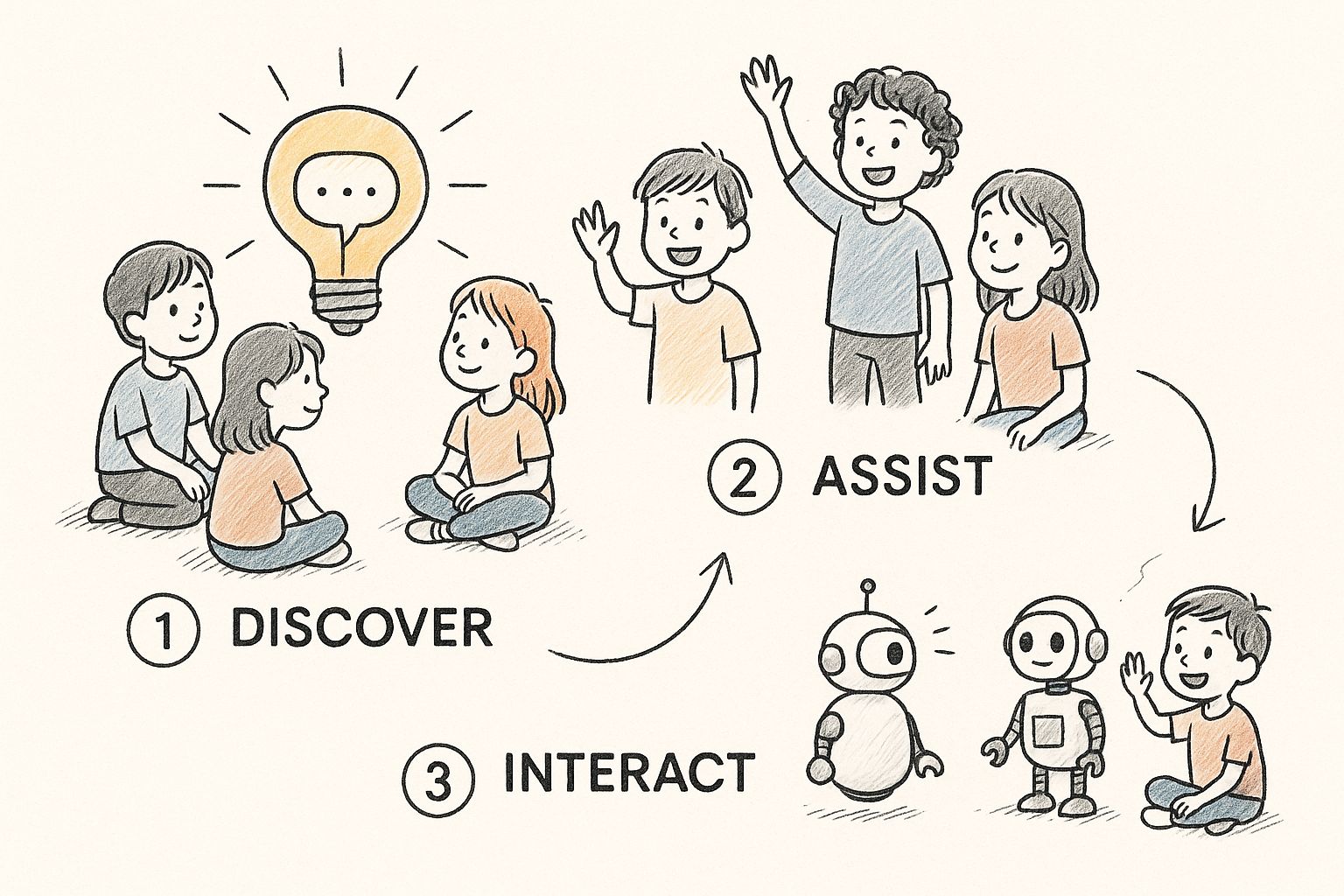
As you can see, it's a clear process. Each piece builds on the last, giving the AI a much clearer picture of what to do.
The Four Building Blocks of a Great Prompt
Let's break down the four key ingredients for a fantastic prompt. I like to use the acronym RT-CF: Role, Task, Context, and Format. It’s a simple mental checklist for kids to run through before they hit "enter."
1. Role: Tell the AI Who to Be
This is often the most fun part! By giving the AI a role, your child sets the entire tone and personality of the response. It's the difference between a dry encyclopedia entry and a thrilling story.
- Before: "Tell me about space." (Yawn.)
- After: "You are a friendly astronaut on the International Space Station. Tell me about what you see outside your window."
2. Task: State Exactly What You Want
This is the mission. What do you actually want the AI to do? The key is using clear, action-oriented words. Instead of a fuzzy idea, you’re giving it a specific job.
- Before: "Story about a dragon."
- After: "Write a short, funny story about a dragon who is secretly afraid of heights."
3. Context: Add the Important Details
This is where the magic happens. Context provides the essential background information that prevents the AI from just making stuff up. It's the who, what, where, and when that makes your child's idea totally unique.
- Before: "Write about a magical forest."
- After: "Write about a magical forest where the trees have leaves made of glass and it only rains lemonade."
4. Format: Explain How You Want the Answer
This final instruction tells the AI how to organize its response. Do you want a list? A poem? A script for a play? Defining the format ensures the answer is actually useful and easy to read.
- Before: "Give me ideas for a birthday party."
- After: "Give me ideas for a space-themed birthday party. Organize them in a table with three columns: Theme, Activity, and Food."
Parent Tip: Try this away from the screen with a "Robot Sandwich" game. Have your child give you a four-part prompt for making a sandwich. You have to follow their instructions exactly as the "robot." They'll quickly see why being specific with each part is so important!
Once you've both got the hang of these four pillars, you can explore more advanced techniques for crafting AI prompts that yield superior results and see how these basics can be built upon for even more complex tasks.
By teaching this simple RT-CF framework, you're handing your child a powerful mental model they can use for anything—from getting unstuck on homework to bringing their wildest creative stories to life.
Adapting Prompting Skills for Different Ages
Let's be real: trying to teach a 7-year-old and a 12-year-old the same thing in the same way is a recipe for disaster. What makes a first-grader giggle will get a massive eye-roll from a pre-teen. The secret to teaching prompt engineering is meeting them exactly where they are.
This isn't about sitting them down for a formal lesson. It’s about weaving the core idea—clear communication gets you cool results—into their world. For the little ones, it’s all about hands-on play. For the older kids, it’s about empowering their projects.

Prompting for Younger Kids (Ages 6-9)
With this crew, the best tools are often screen-free. The mission is to introduce the concept of giving precise instructions through physical, playful games. Think of yourself as a "human robot" that can only follow their commands literally.
A classic I love is "Build the Pillow Fort." Ask your 7-year-old to tell you how to build it. When they say, “Put that pillow over there,” pick up the wrong one and ask, “This one? And where is ‘over there’?” They catch on fast. They learn that specific words—like “Put the big blue cushion on top of the two red pillows”—are what make things happen.
Here are a few simple quests perfect for this age:
- Treasure Hunt Creator: Challenge them to use an AI to write clues for a scavenger hunt around the house. They’ll have to get specific, prompting it with the actual objects and hiding spots.
- Silly Story Starters: Ask the AI to write a story about a "dinosaur who is secretly afraid of broccoli." This shows them how adding one quirky, specific detail (context) makes the outcome way more fun.
Parent Coaching Tip: Embrace the weird results! When the AI misunderstands, laugh about it. Ask, “Huh, that’s not what we wanted. How could we say it differently so the robot understands?” This builds resilience and a playful approach to problem-solving.
Prompting for Older Kids (Ages 10-13)
By this age, your child is ready for bigger, more complex projects. They can start treating AI as a genuine creative partner or a research assistant. The focus shifts from single commands to multi-step thinking and refining prompts to get better and better results.
This is where you see the real power of prompt engineering for kids ignite. They can go beyond simple questions and use AI to organize their homework, brainstorm ideas for a science fair, or dive deeper into their favorite hobbies.
For instance, a 12-year-old can use AI to:
- Outline a School Report: Prompting an AI to "act as a history expert and create a detailed outline for a report on Ancient Egypt" is a game-changer. They can even specify sections on daily life, pyramids, and famous pharaohs.
- Co-write a Short Film Script: Give the AI a plot summary and ask it to generate dialogue between two characters.
- Debug Simple Code: If they're exploring coding, they can paste a code snippet and ask the AI to "explain the error in this Python code like I'm a total beginner."
Experts are already pointing out that by 2025, prompt engineering will be a critical skill for many careers. As more industries embrace generative AI, professionals who can design clean, structured prompts will be in high demand. It’s about moving beyond casual questions to master techniques like zero-shot and chain-of-thought prompting. You can read more about how these trends are shaping the jobs of tomorrow on refontelearning.com.
This is where a platform like Kubrio shines. It helps you design learning quests that are perfectly tailored to your child's age and passions, making the whole process feel less like a lesson and more like an adventure.
How to Create Your First AI Learning Quest
Alright, let's move past the theory and get our hands dirty. This is where the real fun begins, as you and your child team up to create something totally new. You're about to shift from just watching to actively designing a learning adventure.
Using Kubrio’s AI Learning Activity Generator, you can take whatever your child is currently obsessed with—dinosaurs, fashion, far-off planets—and spin it into a structured learning quest in just a few minutes.
This isn't about adding another task to their plate. It's about framing learning as play, which is the secret sauce to practicing prompt engineering for kids.
You’re the Learning Designer
Think of yourself as the director and your child as the star of their own movie. You don't need a detailed script, just a great starting point. The AI Learning Activity Generator acts as your co-writer, helping you flesh out the scenes.
Your main job is to provide that initial spark. What's lighting up your child’s imagination right now?
- Is your 8-year-old suddenly an expert on ancient Rome after a school project?
- Does your 11-year-old dream of designing characters for their own video game?
- Is your 6-year-old captivated by the strange creatures of the deep sea?
Whatever that interest is, that's your theme. You just feed that simple idea into the generator, and it builds a quest around it, complete with milestones and challenges that feel like a game. For more inspiration, check out our resource on "Prompt Engineering for Kids: Quest Creator".
Step-by-Step Example: The "Dino-Discovery" Quest
Let's build a quest right now. Picture this: your 9-year-old just finished a dinosaur book and is buzzing with ideas.
Instead of a rigid "Step 1, Step 2," think of it as a creative conversation with the tool.
- Open the AI Learning Activity Generator in Kubrio. You'll see a clean, simple prompt asking for your child's interest.
- Give it the core idea. Just type something like, "Invent a new dinosaur."
- Choose a skill to focus on, maybe "Creative Writing" or "Scientific Thinking," to give the quest a bit of direction.
- Hit the generate button and watch the magic happen.
In seconds, Kubrio will craft a multi-step quest. It’s not just one to-do item; it's a full-blown project. For our dino-loving kid, it might create something called "The Dino-Discovery Mission," with milestones like:
- Milestone 1: Brainstorm your new dinosaur’s name, diet, and special powers. Use the AI as your creative partner to come up with wild ideas.
- Milestone 2: Write a habitat profile. What did its world look like? Describe the plants, climate, and other animals living nearby.
- Milestone 3: Bring it to life! Create a picture of your dinosaur in its habitat using an AI image generator.
This is exactly the kind of hands-on, project-based learning we explore in our guide on "prompt engineering quests for kids".
When you turn a fleeting interest into a real project, you're sending a powerful message: your passions matter. They are the starting point for real creation and learning. This is how you raise a high-agency kid.
The best part? You can easily tweak the complexity. The tool does the heavy lifting, layering in challenges perfect for their age. A younger child’s quest might focus more on verbal storytelling, while an older kid’s could involve deeper research and world-building. This keeps learning exciting and never overwhelming.
Quick-Start Activity: Create a Mythical Creature
Ready to try right now? Sit with your child and open your favorite AI chatbot. Use this template:
Prompt Template: "Act as a world-famous mythologist. We want to invent a new mythical creature.
- Its name is: [Your child fills this in]
- It lives in: [Your child fills this in, e.g., 'a crystal cave behind a waterfall']
- Its special power is: [Your child fills this in, e.g., 'it can sing flowers into bloom']
- Its secret weakness is: [Your child fills this in, e.g., 'the smell of chocolate'] Now, write a short, exciting story (3 paragraphs) about our creature's first adventure."
This simple activity covers role, context, and task, giving your child an immediate taste of success.
Turning AI Feedback Into Deeper Learning
A conversation with AI isn't a one-and-done command. It's more like a dance. Your child’s first prompt is just the opening move; the real magic—and the deep learning—happens in the back-and-forth that follows.
It's common for kids to get frustrated when an AI spits out a weird or unhelpful answer. But these moments are golden. They're a chance to teach resilience and show that problem-solving is almost always an iterative process. This is the perfect time to introduce the core idea of prompt engineering: figuring out how to ask better questions based on the answers you get.
It’s a puzzle, not a dead end.
A Simple Framework for Analyzing AI Answers
To make this feel less abstract, we can borrow a mental model from Kubrio's Triple-Angle Feedback system. It’s a simple framework you can use to coach your child the moment an AI response lands. Just ask them three quick questions inspired by our feedback angles: Krea, Tek, and Brio.
- Was it Creative? (Krea): Did the AI dream up anything cool or imaginative? If not, how could we ask it to be more playful or think outside the box? Maybe we need to add a word like "surprise me" or "invent a new..."
- Was it Correct? (Tek): Did it get the facts right? If the answer feels a bit off, what other clues or details could we add to our prompt to give the AI better information to work with?
- Was it Clear? (Brio): Was the answer easy to follow? If it was too long or confusing, how could we ask it to reformat the information? Maybe we can ask for a bulleted list, a simple one-sentence summary, or even a table.
This little "Krea-Tek-Brio" check-in instantly reframes a confusing AI response into your child’s next strategic move. It helps them shift from, "Ugh, this is dumb," to, "Hmm, how can I ask this better?"
Parent Coaching Tip: When the AI says, "I don't understand," frame it as an exciting challenge. Try something like, “The AI is a bit confused! It’s our job to be super-clear detectives and give it better clues. What should we try next?”
Why This Feedback Loop Builds Stronger Brains
This process of refining prompts based on what comes back is so much more than a simple tech skill. It's a direct workout for their metacognition—the powerful ability to think about their own thinking.
As your child gets into the habit of analyzing why a prompt didn't work and brainstorming how to fix it, they are building a mental muscle that will help them in every other area of learning. The whole cycle of prompt-feedback-refine is the absolute core of communicating effectively with AI. By showing them how to analyze and respond to what the AI gives them, you're not just teaching them about technology. You're teaching them how to become more adaptable, resilient, and precise thinkers for life.
Building a Portfolio of Your Child's AI Projects
So, how do you actually see your child's progress in a skill as fluid as AI communication? A traditional report card just doesn't cut it. You can't capture the creative spark and problem-solving that goes into mastering prompt engineering for kids with a simple letter grade.
The real evidence of their growth isn't a test score; it's the incredible stuff they create.
This is why we believe so strongly in a living, breathing portfolio. It's so much more than a digital scrapbook of completed projects. Think of it as a dynamic, evolving showcase of your child's journey from curious beginner to confident creator.
From Fridge Art to a Future-Ready Résumé
Kubrio’s Living Skill Portfolio was built for exactly this. Every time your child completes a quest—whether they're inventing a new species of dinosaur or drafting a mission plan to Mars—it's automatically added to their personal gallery. This isn't just a list of finished tasks; it’s a story of their development.
You get a front-row seat to watch their prompting skills sharpen over time. That simple, one-line request from last month? It might have evolved into a sophisticated, multi-step prompt that generates a richly detailed story or a full-blown project plan. The portfolio makes this evolution tangible.
This isn't just a record of what your child has done; it's a testament to how they think. It’s visible proof of their ability to communicate with technology, solve problems creatively, and turn their curiosity into genuine competence.
This kind of portfolio demonstrates true mastery of /skills/prompt-engineering through tangible results. It’s the ultimate "show, don't tell" for 21st-century skills—a source of pride they can look back on and a powerful foundation for a lifetime of high-agency learning.
Questions Every Parent Asks About Kids and AI
Whenever a new piece of tech enters our homes, it’s natural to have questions. You're not alone. Let's walk through some of the big concerns I hear from parents all the time when it comes to kids and AI.
Is AI Actually Safe for My Child to Use?
This is the big one, and rightly so. Safety comes first, always.
The good news is that most of the major AI tools you've heard of, like ChatGPT or Claude, have safety filters built right in. They're designed to catch and block inappropriate content before it ever reaches your child.
But the real key? Your involvement. Especially in the beginning, treat AI exploration as a team sport. Sit down together, play with the tools, and set ground rules just like you would for a new video game or social media app. It’s about shared discovery, not solo screen time.
What Happens When the AI Gets It Wrong?
Sooner or later, the AI will say something goofy, factually incorrect, or just plain weird. Honestly, this is one of my favorite parts. It's a golden opportunity for a real-world lesson.
When the AI spits out a bizarre "fact," it’s the perfect moment to teach your child one of the most important skills they'll ever learn: critical thinking.
Parent Coaching Prompt: Frame it as a fun investigation. "Whoa, that sounds a little off, doesn't it? Let's be detectives and see if we can find the real answer."
This simple habit reminds them that AI is just a tool—a powerful one, but still just a tool. It's not a source of absolute truth. This teaches them to question, to verify, and to think for themselves.
How Do I Keep This From Becoming More Screen Time?
I get it. The last thing any of us wants is another reason for our kids to be glued to a screen.
But here’s the secret: prompt engineering for kids is really about a way of thinking, not a specific app. You can practice the core skills completely offline.
Try playing "Human Robot." Ask your child to give you perfectly clear, step-by-step instructions for a simple task, like making a sandwich or building a small LEGO model. They have to be the "prompter," and you're the "robot" who follows their commands literally. This fun, screen-free game builds the exact same logic and clarity muscles needed for AI.