
10 Social Emotional Learning Activities to Build Real-World Skills
In a world that changes fast, knowing how to manage emotions, collaborate, and bounce back from setbacks is more important than ever. While passive, one-size-fits-all learning often leaves kids unprepared, you can equip your child with real-world skills right at home. This guide offers ten practical social emotional learning activities designed for busy families looking for meaningful engagement beyond the screen.
Each activity is a 10- to 45-minute quest you can start tonight. They're built to help your child develop agency—their ability to understand themselves, connect with others, and take meaningful action. Forget abstract theories; these are concrete projects that build the grit, empathy, and creativity your child needs for a complex future.
We'll provide actionable steps, materials lists, and reflection prompts for each activity, ensuring you have everything needed to get started immediately. Get ready to explore a toolkit that moves beyond simple quizzes to build lasting emotional intelligence and resilience.
1. Mindfulness and Breathing Quests
Mindfulness and Breathing Quests are guided practices that help children develop awareness of their thoughts and feelings through focused breathing. Rather than just passively listening, the goal is to create a tangible 'calm-down plan' they can use independently. This approach transforms a simple exercise into a powerful tool for self-regulation, giving kids agency over their emotional state. It's one of the most effective social emotional learning activities for building foundational emotional intelligence.

How It Works
The core idea is to create a physical artifact or a designated space associated with calm. A "breathing buddy" (a small stuffed animal placed on the belly) provides immediate visual feedback as it rises and falls with each breath, helping your child focus.
Actionable Tips
- Time: 10 min • Materials: Small stuffed toy, paper, colored pencils • Safety: A quiet, comfortable space • No-kit option: Use a hand on the belly instead of a toy.
- Pick the spark: "Because you like superheroes, let's practice 'superhero focus breathing' to power up our minds."
- Draft 3-5 steps:
- Find a comfy spot to lie down.
- Place your breathing buddy on your belly.
- Breathe in slowly through your nose and watch your buddy rise.
- Breathe out slowly through your mouth and watch it fall.
- Try this for 10 breaths.
- Feedback prompts: "Show me your version one breath map. What will you change for version two to make it feel even calmer?"
2. Circle of Friends/Restorative Circles
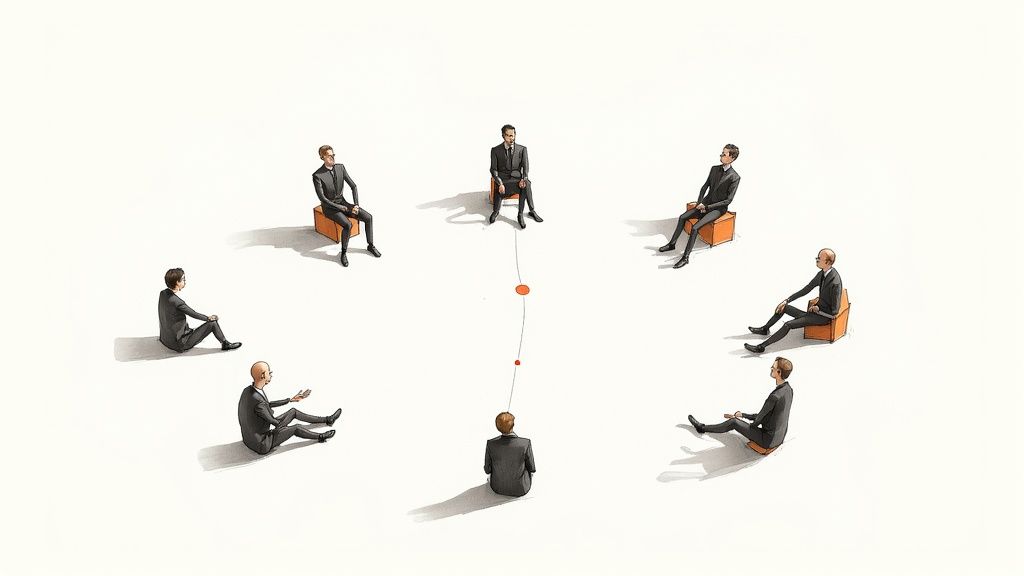
Circle of Friends, also known as Restorative Circles, is a structured discussion where children sit together to share experiences and resolve conflicts. This process moves beyond one-size-fits-all discipline by creating a space for empathy and mutual understanding. Participants take turns speaking while others listen respectfully, giving every child agency in maintaining a healthy, supportive group dynamic. It is a cornerstone of social emotional learning activities focused on communication.
How It Works
Using a "talking piece"—a special object that grants the holder the right to speak without interruption—ensures balanced participation. This simple constraint slows down reactive communication and encourages thoughtful listening.
Actionable Tips
- Time: 20 min • Materials: A "talking piece" (a smooth stone, a special toy) • Safety: A comfortable circle where everyone can see each other.
- Pick the spark: "Because we all want to feel heard, let's use this talking piece so everyone gets a turn to share without being interrupted."
- Draft 3-5 steps:
- Sit in a circle and review the one rule: only the person with the talking piece speaks.
- The first person holds the piece and answers a prompt (e.g., "Share one happy thing from your week").
- They pass the piece to the next person.
- Continue until everyone who wants to share has had a turn.
- Feedback prompts: "Where did you get stuck, and how did you unstick it?" "I love how you listened while waiting for your turn."
3. Emotion Check-in and Feelings Identification
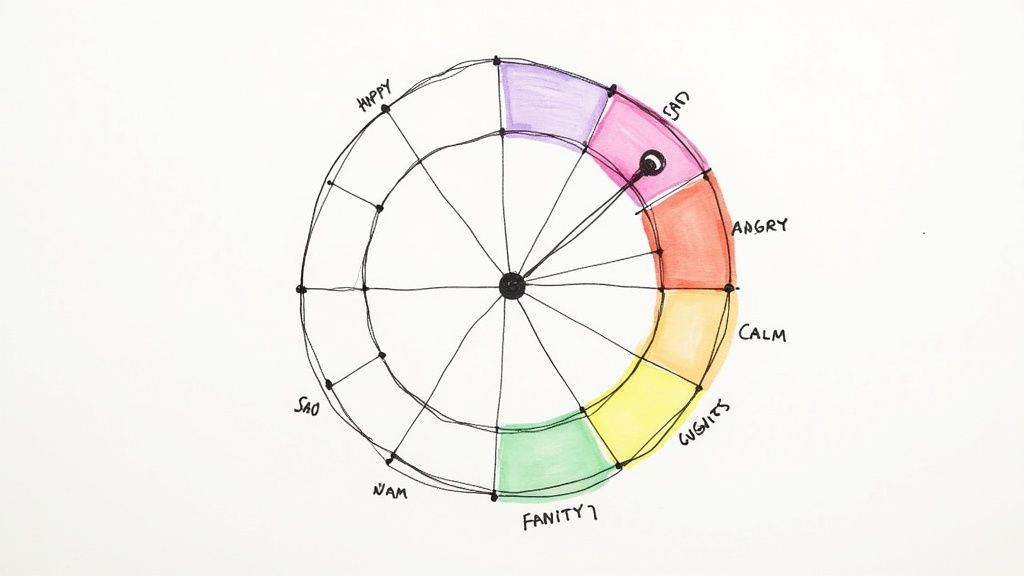
Emotion Check-ins are structured moments where children identify and name their current feelings. This practice moves beyond the generic "how are you?" by using tools like mood meters to build a specific emotional vocabulary. Instead of abstractly discussing emotions, this method provides a tangible framework for children to develop self-awareness. It's one of the most foundational social emotional learning activities for creating an environment where feelings are understood, not judged.
How It Works
The core principle is to make identifying emotions a consistent, low-pressure routine. By using visual aids, children can point to a feeling even if they don't have the words for it yet. The goal is to normalize talking about feelings, giving your child the agency to communicate their internal state.
Actionable Tips
- Time: 10 min • Materials: Paper, markers • Safety: A non-judgmental space • No-kit option: Use facial expressions or hand gestures to represent feelings.
- Pick the spark: "Because you love drawing, let's create our own 'Feelings Board' with faces for happy, frustrated, and tired."
- Draft 3-5 steps:
- Draw 4-5 faces showing different emotions on a piece of paper.
- Label each one (e.g., "Excited," "Calm," "Worried").
- At a set time each day (like breakfast), ask everyone to point to the feeling that's closest to theirs.
- Share why you picked your feeling.
- Feedback prompts: "Show me your v1 feelings board. What will you change in v2?"
4. Gratitude and Appreciation Practices
Gratitude Practices are structured activities that shift a child’s focus toward recognizing the positive aspects of their lives. It's about building a consistent habit of noticing and acknowledging people or experiences that bring joy. By making gratitude a tangible, shared practice, children develop a more optimistic outlook and strengthen their social bonds.
How It Works
The core idea is to transform the abstract feeling of gratitude into a concrete action. Creating a physical artifact like a gratitude journal or a "thankful jar" makes the emotion real and memorable. These regular, intentional actions train the brain to scan for positives.
Actionable Tips
- Time: 10 min • Materials: A jar, small slips of paper, a pen • Safety: Focus on genuine feelings, not forced positivity.
- Pick the spark: "Because we all have good things happen, let's create a Thankful Jar to collect them."
- Draft 3-5 steps:
- Decorate a jar and label it "Our Thankful Jar."
- Place it somewhere visible with slips of paper and a pen nearby.
- Once a day, have each family member write down one specific thing they're grateful for and add it to the jar.
- Once a week, read the slips aloud together.
- Feedback prompts: "Which step took the most effort, and what would you try next time?"
5. Perspective-Taking and Empathy Scenarios
Perspective-Taking Scenarios are structured exercises that challenge children to step into someone else's shoes. Instead of just learning about feelings, kids actively analyze a situation from a different viewpoint. This moves beyond the passive advice to "be kind" by creating a tangible framework for understanding others' emotions, motivations, and needs.
How It Works
By using relatable stories or role-playing conflicts, children practice identifying feelings and motivations that aren't their own. Discussing a character's difficult choice in a book makes empathy an active process of inquiry, giving your child agency in how they interpret social situations.
Actionable Tips
- Time: 20 min • Materials: A favorite book or short video clip • Safety: Choose scenarios without overly distressing content.
- Pick the spark: "Since you love that movie, let's pause it here and figure out what the villain might be thinking. Why do you think they're doing this?"
- Draft 3-5 steps:
- Choose a scene with a clear conflict or a strong emotion.
- Pause and ask, "How do you think that character feels right now?"
- Then ask, "What about the other character? How might they be feeling?"
- Brainstorm one thing the characters could do differently.
- Feedback prompts: "That's one way to see it. What's another way?"
6. Collaborative Problem-Solving Quests
Collaborative Problem-Solving Quests are structured group tasks where children must communicate, compromise, and combine their strengths to reach a common goal. This shifts the focus from individual achievement to collective success. Rather than simply playing together, these activities create a scenario where success depends entirely on teamwork, building trust and communication skills in a tangible way.
How It Works
By creating a challenge that no single child can solve alone, such as building a bridge with limited supplies, the activity necessitates clear communication. These social emotional learning activities make abstract concepts like compromise and leadership concrete.
Actionable Tips
- Time: 20 min • Materials: Recycled materials (cardboard tubes, tape, string) • Safety: Adult nearby for any cutting • No-kit option: Build a story together, with each person adding one sentence at a time.
- Pick the spark: "Because we're a team, let's try this mission: build the tallest free-standing tower you can in 15 minutes using only these materials."
- Draft 3-5 steps:
- Set out the materials and explain the goal.
- Give the team 3 minutes to make a plan.
- Set a timer for 10 minutes to build.
- At the end, measure the tower.
- Feedback prompts: "What changed between v1 and v2 of your plan?" "Where did you get stuck and how did you unstick it?"
7. Self-Advocacy and Assertive Communication Training
Self-Advocacy Training explicitly teaches children how to express their needs, set boundaries, and share opinions respectfully. The goal is to move beyond passive or aggressive responses and develop a confident, clear voice. This transforms potentially fraught situations into opportunities for growth, giving kids the scripts and confidence to manage conflict and ask for help.
How It Works
The core idea is to demystify communication by providing concrete tools like "I" statements. Instead of simply telling a child to "speak up," this approach gives them the exact words to use. Through role-playing, children practice these skills in a safe environment.
Actionable Tips
- Time: 15 min • Materials: None • Safety: Practice with light-hearted scenarios first.
- Pick the spark: "Because you want to join the soccer game at recess, let's practice how you could ask the group."
- Draft 3-5 steps:
- Introduce the "I feel..." formula: "I feel [emotion] when [situation] because [reason]. I would like [request]."
- Provide a simple scenario (e.g., "someone cuts in line").
- Role-play the scenario using the formula.
- Switch roles and try again.
- Feedback prompts: "Show me v1 of your request. Now how can we make v2 even more confident and clear?"
8. Goal-Setting and Growth Mindset Workshops
Goal-Setting and Growth Mindset Workshops are structured activities that teach children that their abilities can be developed through hard work. Instead of seeing skills as fixed, this approach frames challenges as opportunities to grow. It empowers kids to take ownership of their progress by setting meaningful goals, tracking them, and learning from setbacks.
How It Works
The core idea is to make the process of achievement visible and celebrate effort, not just the outcome. This is done by breaking large goals into small steps and using visual tools to track progress. This transforms abstract ambitions into concrete plans. For more guidance, explore strategies for goal setting for kids on kubrio.com.
Actionable Tips
- Time: 20 min • Materials: Large paper, sticky notes, markers • Safety: Focus on process, not pressure.
- Pick the spark: "Because you want to learn that new song on the piano, let's map out a 'Piano Master Mission' to get there."
- Draft 3-5 steps:
- Write the main goal at the top of the paper.
- Brainstorm the small steps needed to reach it (e.g., "practice scales," "learn first four bars").
- Write each step on a sticky note and place them in order on the paper.
- As a step is completed, move the sticky note to a "Done" section.
- Feedback prompts: "I love how you changed your plan after testing." "Show me your favorite mistake and what it taught you."
9. Conflict Resolution and Peer Mediation
Conflict Resolution and Peer Mediation are structured systems that empower children to manage disagreements constructively. Instead of relying on adult intervention, these programs teach kids communication and negotiation skills. This approach shifts the dynamic from punishment to problem-solving, giving children the agency to repair relationships and find mutually agreeable solutions.
How It Works
The core principle is teaching a step-by-step process for de-escalating conflicts. The goal isn’t to assign blame but to help both sides articulate their needs and brainstorm solutions. This builds a sense of community responsibility and equips children with lifelong communication skills.
Actionable Tips
- Time: 20 min • Materials: Paper and pen • Safety: Adult facilitates until kids are confident with the steps.
- Pick the spark: "Because you two often argue over the tablet, let's create a 3-step plan we can use every time."
- Draft 3-5 steps:
- Step 1: Cool Down. Take a 5-minute break.
- Step 2: Each person explains their side using "I feel..." statements, without interruption.
- Step 3: Brainstorm three possible solutions that could work for both of you.
- Agree on one solution to try.
- Feedback prompts: "What decision mattered most, and where else could it apply?"
10. Self-Care and Coping Skills Instruction
Self-Care and Coping Skills Instruction involves directly teaching children a toolkit of healthy strategies to manage stress, disappointment, and big emotions. Instead of leaving them to guess how to handle challenges, this approach equips them with concrete, actionable techniques. It shifts the focus from reacting to a crisis to proactively building emotional resilience.
How It Works
The goal is to build a personalized menu of coping mechanisms your child can turn to independently. This involves practicing various strategies during calm moments and helping your child identify what works best for them. For direct support, resources like calming stories for anxiety relief can offer effective techniques.
Actionable Tips
- Time: 20 min • Materials: Shoebox, paper, markers, comforting items (stress ball, small blanket) • Safety: Acknowledge that all feelings are okay.
- Pick the spark: "Let's make a 'Calm-Down Kit' together. What are three things we can put in it that help you feel better when you're frustrated?"
- Draft 3-5 steps:
- Decorate the shoebox.
- Brainstorm a list of calming activities (e.g., "listen to music," "draw," "squeeze a stress ball").
- Write or draw each idea on a small card.
- Gather the items and cards and put them in the box.
- Feedback prompts: "Let's see v1 of your kit. What could we add for v2 to make it even more helpful?"
Comparison of 10 Social-Emotional Learning Activities
| Practice | Time (Mins) | Materials | Key Skill | Great For... |
|---|---|---|---|---|
| Mindfulness and Breathing | 10 | Low | Self-Regulation | Quick breaks, managing anxiety |
| Circle of Friends | 20 | Low | Communication | Family meetings, resolving conflicts |
| Emotion Check-in | 10 | Low | Self-Awareness | Daily routines, building vocabulary |
| Gratitude Practices | 10 | Low | Optimism | Weekly rituals, fostering empathy |
| Perspective-Taking | 20 | Low-Medium | Empathy | Storytime, movie nights |
| Collaborative Problem-Solving | 20 | Medium | Teamwork | Sibling projects, creative play |
| Assertive Communication | 15 | None | Self-Advocacy | Practicing for real-world situations |
| Goal-Setting | 20 | Medium | Grit | New projects, skill-building |
| Conflict Resolution | 20 | Low | Negotiation | Sibling disagreements |
| Self-Care & Coping Skills | 20 | Medium | Resilience | Building a personal toolkit for stress |
From Activities to Agency: Building a Lifelong Skill
The social emotional learning activities in this guide are tools for building your child’s sense of agency. Moving beyond the passive model of worksheets, these practices give children the hands-on experience they need to navigate their inner worlds and build meaningful relationships. Each activity is a stepping stone toward genuine self-direction and resilience.
The goal isn’t perfection. It’s about creating a consistent rhythm of practice. Think of these tools as a library of strategies your child can draw upon when they face a challenge. By integrating these practices into your family’s routine, you're cultivating a mindset where challenges are seen as opportunities for growth.
Start from any spark—dinosaurs, video editing, chess tactics. Kubrio drafts right-sized quests (10, 20, or 45 minutes) and guides you on what feedback to give. Finished work saves to a portfolio so growth is simple to see and share.
Your Actionable Next Steps
To turn these ideas into lasting habits, focus on intentional integration.
-
Co-select an Activity: Sit down with your child and review the list. Ask them, “Which one of these sounds interesting to try this week?” Giving them a choice immediately fosters a sense of ownership.
-
Schedule a "Quest" Time: Dedicate a specific, recurring 20-minute slot. This consistency signals its importance and turns it from a one-off task into a reliable family practice.
-
Focus on Reflection, Not Perfection: The real learning happens when you debrief. After trying an activity, use simple prompts like, “What was the trickiest part of that, and what did you learn from it?” This reinforces that effort and iteration are more valuable than a perfect first attempt.
Ultimately, these social emotional learning activities are about equipping your child with the internal compass they need to thrive. Each time they successfully identify an emotion, listen to another's perspective, or advocate for their needs, they move from being passive consumers of information to active architects of their own emotional well-being. This is the heart of building agency.