
Top Stem Activities Elementary School Kids Will Love
The world is changing faster than ever. The skills that matter are not about memorizing facts, but learning how to question, build, and solve complex problems. For future-ready parents, this shift starts early, not in a formal classroom, but on the living room floor with cardboard, tape, and a spark of curiosity. The challenge isn't just to keep kids busy; it's to cultivate the high-agency, growth-mindset thinking that will define their success.
This guide moves beyond generic craft projects to offer a curated list of powerful STEM activities for elementary school students. Each activity is a micro-lesson in first-principles thinking, designed to teach your child not just what to think, but how to think like an innovator. These aren't just one-off projects; they are frameworks for building the builders of tomorrow.
Within this article, you will discover a collection of hands-on, easy-to-implement projects that require minimal setup but deliver maximum learning. We will break down each activity into simple steps, outline the necessary materials, and explain the core scientific and engineering concepts at play. Let's explore how to turn everyday materials into foundational lessons in physics, biology, and coding.
1. Egg Drop Challenge
The Egg Drop Challenge is a quintessential engineering project that has become a staple in STEM education for good reason. It tasks students with designing and building a protective container that can keep a raw egg intact when dropped from a significant height. This activity is a fantastic introduction to the engineering design process: brainstorming, designing, building, testing, and iterating. It's one of the most engaging stem activities elementary school teachers can facilitate because it combines hands-on creativity with core physics principles.
Students directly engage with concepts like gravity, force, drag, and shock absorption. By selecting materials and constructing their devices, they make tangible connections between their design choices and the scientific outcomes. The challenge isn't just about success or failure; it's about understanding why a design worked or didn't and using that knowledge to improve it.
Why This Challenge Works
This activity excels at making abstract scientific concepts concrete and personal. When a student sees their carefully constructed device protect the egg, they gain an intuitive understanding of impact absorption.
- Promotes Iterative Design: Failure is part of the process. An egg that breaks is not a failed project but a data point for the next design iteration.
- Encourages Critical Thinking: Students must predict which materials will be effective and justify their design choices, fostering analytical skills.
- Highly Adaptable: The challenge can be scaled for different age groups by adjusting the height of the drop, limiting materials, or adding budget constraints.
The infographic below outlines the core parameters for a typical elementary-level challenge, including material constraints and expected success rates at different heights.
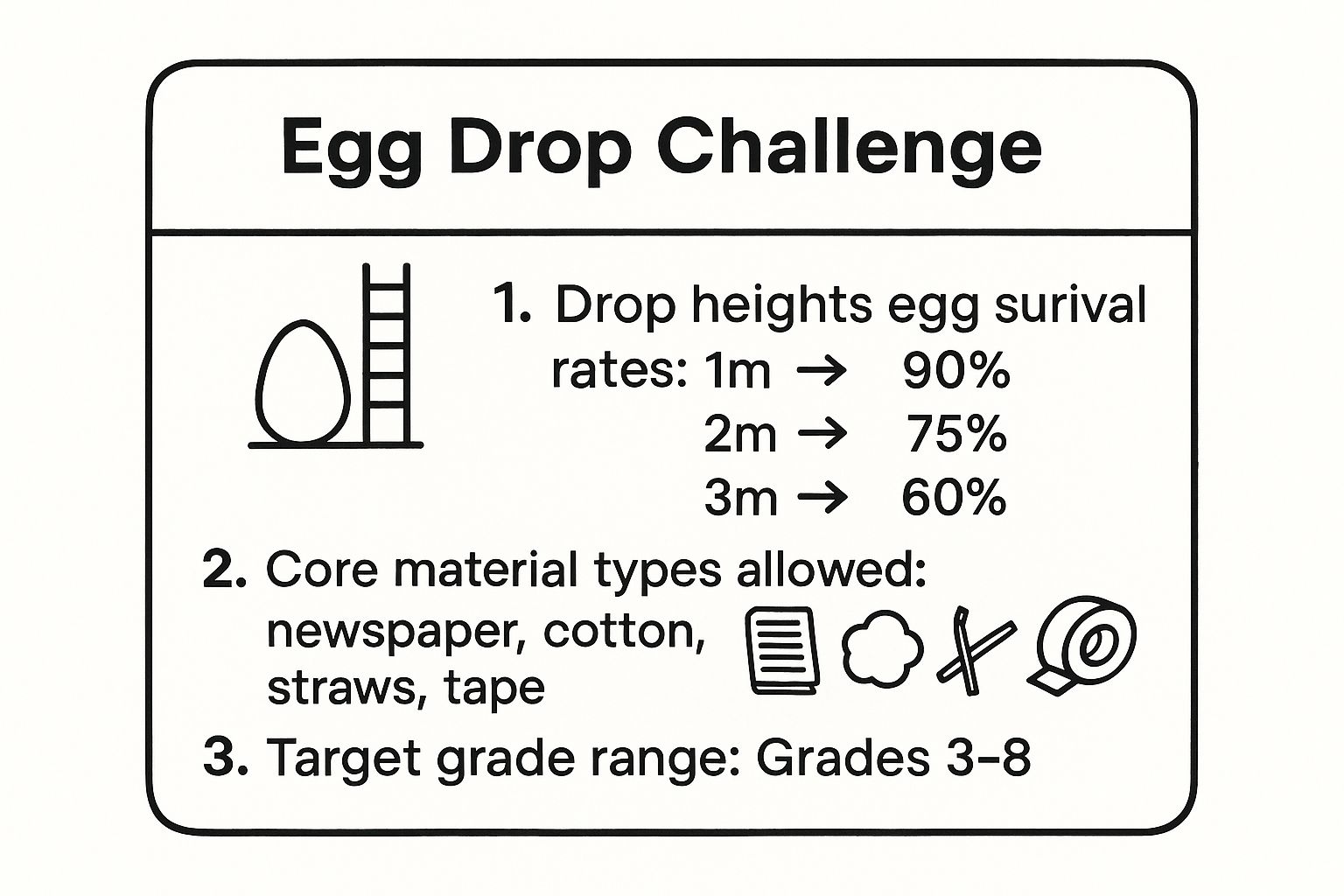
As the visualization shows, increasing the drop height significantly raises the difficulty, pushing students to refine their shock-absorbing and stability features. This data provides a clear framework for setting up a progressive and challenging learning experience.
2. Simple Machines Exploration
A Simple Machines Exploration is a foundational physics activity that introduces students to the six classical simple machines: the lever, wheel and axle, pulley, inclined plane, wedge, and screw. This hands-on investigation focuses on how these fundamental mechanisms make work easier by manipulating force and distance. It is one of the most effective stem activities elementary school teachers can use to demystify complex engineering principles, showing how everyday objects from scissors to playground slides are built on these core concepts.
Students gain a tangible understanding of mechanical advantage by building and testing their own devices. They might construct a pulley system from bottle caps and string to lift classroom supplies or design ramps (inclined planes) to move heavy books with less effort. This process connects abstract physics to real-world applications, revealing the hidden science in the tools they use daily. The goal is to see how simple designs can produce powerful results.
Why This Challenge Works
This activity excels at breaking down complex engineering into simple, observable components. When students use a spring scale to measure the force needed to pull a block up a ramp versus lifting it straight up, they internalize the concept of mechanical advantage through direct experience.
- Connects to Everyday Life: By identifying simple machines in their environment, from doorknobs (wheel and axle) to zippers (wedge), students see that science and engineering are all around them.
- Encourages Systematic Thinking: Students learn to analyze problems and identify which simple machine is best suited to solve them, fostering problem-solving skills.
- Scalable and Collaborative: The activity can be as simple as a scavenger hunt or as complex as building a compound machine that combines multiple simple machines to perform a task.
The infographic below highlights how different simple machines are present in common classroom and playground objects, providing a visual guide for a school-wide scavenger hunt.
As the visualization illustrates, even a basic playground is a complex system of levers, inclined planes, and screws. This framework helps students see the engineering embedded in their world, making abstract scientific principles concrete and relatable.
3. Bridge Building Challenge
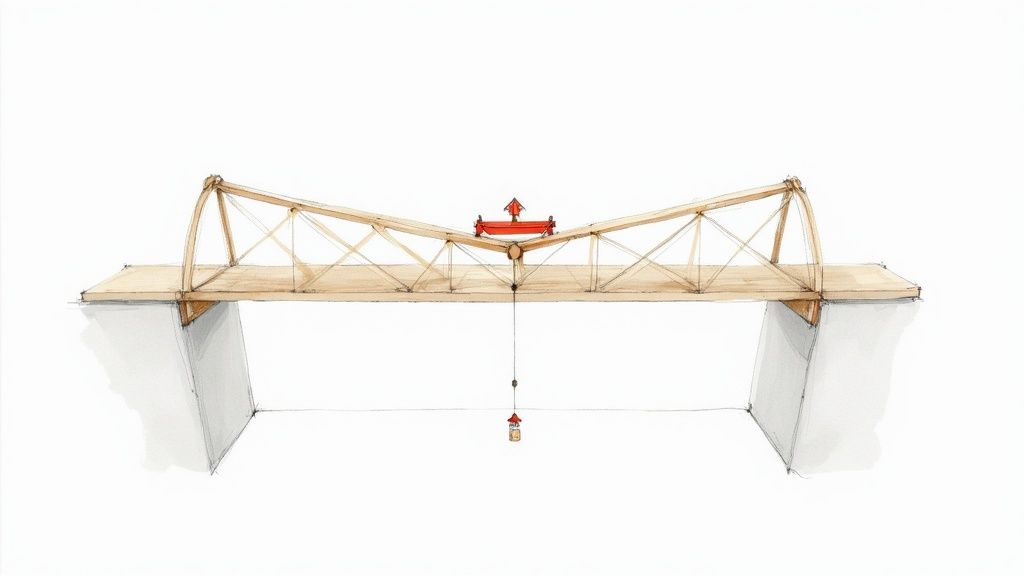
The Bridge Building Challenge is a classic engineering project that introduces young students to the principles of structural integrity, load distribution, and material science. Participants are tasked with designing and constructing a bridge from a limited set of materials, such as popsicle sticks, straws, or paper, that can span a predetermined gap and support as much weight as possible. This activity is a standout among stem activities elementary school teachers can use because it directly mirrors real-world civil engineering and physics in a tangible, exciting way.
Students learn about the strength of different geometric shapes, particularly the triangle, and see firsthand how concepts like tension and compression work. As they test their bridges to failure, they gather crucial data about their design's strengths and weaknesses, making the engineering design process come alive.
Why This Challenge Works
This activity demystifies complex engineering concepts by making them hands-on and goal-oriented. Students aren't just learning about bridges; they are becoming engineers tasked with solving a specific problem, a core skill that is further explored in other problem-solving activities. You can learn more about other problem-solving activities on Kubrio.com.
- Illustrates Core Physics: The challenge provides a clear, physical demonstration of how forces act upon structures and why certain designs are superior.
- Fosters Systematic Testing: Students must test their bridges methodically, adding weight incrementally and documenting the results, which introduces them to scientific data collection.
- Encourages Research and Planning: Before building, students can research famous bridges like the Golden Gate Bridge to understand different designs (e.g., truss, arch, suspension) and apply those ideas to their own creations.
This project is a powerful way to show students that engineering is about creativity, testing, and continuous improvement. The moment a seemingly fragile structure holds an unexpectedly heavy load is an unforgettable learning experience.
4. Coding with Scratch Jr.
Coding with Scratch Jr. introduces young students to the foundational concepts of computer programming in a fun and accessible way. Developed by MIT Media Lab, this visual programming language uses interlocking graphical blocks to represent code, allowing children to create their own interactive stories, games, and animations. This approach removes the barrier of complex syntax, making it one of the most effective stem activities elementary school educators can use to foster computational thinking and digital literacy from an early age.
Students learn core programming logic such as sequencing, loops, and conditional statements by snapping blocks together to make characters move, jump, talk, and interact. The platform encourages creativity and problem-solving as children figure out how to translate their imaginative ideas into executable commands. By building a simple game or an animated story, they engage directly with technology as creators, not just consumers, which is a crucial mindset for future success.
Why This Challenge Works
This activity demystifies coding and presents it as a powerful tool for storytelling and creation. It builds a strong, positive foundation for more advanced programming languages later on and connects logical thinking with creative expression.
- Develops Computational Thinking: Students learn to break down complex problems into smaller, manageable steps, a skill applicable across all academic disciplines.
- Encourages Storytelling: By creating animated narratives, students can connect coding to literacy, sequencing events, and developing characters.
- Fosters Collaboration: Children can share their projects with classmates, providing and receiving feedback, which helps them learn from one another and improve their creations.
The intuitive, block-based interface makes programming accessible for early learners, allowing them to see the immediate results of their code. For a deeper dive into programming projects for kids, you can explore various coding activities and find inspiration. Learn more about coding activities on kubrio.com. This resource offers additional ideas for expanding on the concepts introduced in Scratch Jr.
5. Plant Growth Experiments
Plant Growth Experiments bring botany and the scientific method to life in a way that is both tangible and deeply engaging. This activity guides students to design and conduct controlled experiments exploring the factors that affect plant growth, such as light, water, and soil type. It’s an excellent way to introduce concepts of biology, environmental science, and data analysis over a period of time. This is one of the most effective stem activities elementary school teachers can use to teach patience, observation, and methodical investigation.
Students directly engage with the fundamentals of experimental design: forming a hypothesis, identifying variables (independent, dependent, and controlled), collecting data, and drawing conclusions. By comparing how seeds grow in different conditions, like under colored lights or in various soil mixtures, they learn how external factors influence living organisms. The process is not just about growing a plant; it's about systematically discovering what helps it thrive.
Why This Challenge Works
This activity demystifies the scientific process by making it accessible and observable. As students chart daily changes in height or leaf count, they gain a firsthand understanding of data collection and how patterns emerge over time. To deepen their understanding, children can also explore the properties of different growing mediums by learning how to testing soil at home.
- Teaches Long-Term Observation: Unlike single-day projects, this experiment requires consistent attention and recording, building skills in patience and diligence.
- Emphasizes Controlled Variables: Students learn the importance of changing only one factor at a time to isolate its effect, a cornerstone of scientific inquiry.
- Connects to Real-World Applications: The findings can be linked directly to agriculture, gardening, and environmental conservation. You can find more ideas for connecting these concepts in our guide to sustainability activities for kids.
6. Density Tower Creation
The Density Tower is a visually captivating experiment that makes the abstract concept of density tangible and easy to understand for young learners. The activity involves carefully layering different liquids, such as honey, dish soap, water, and oil, in a clear container to create a colorful, stratified column. This simple yet profound demonstration provides a direct look at how liquids with different densities interact, introducing foundational concepts in chemistry and physics. It's one of the most memorable stem activities elementary school students can participate in because it combines scientific inquiry with an almost magical visual result.
Students get to observe firsthand that liquids have different weights for the same volume, a core principle of density. As they pour each layer and watch them settle, they are engaging with concepts like immiscibility (why oil and water don't mix), buoyancy, and fluid dynamics. Dropping small objects into the tower adds another layer of discovery, as students can predict and observe where an item like a grape or a piece of plastic will settle based on its own density relative to the liquid layers.
Why This Challenge Works
This activity excels at transforming a fundamental scientific principle into an interactive art project. The immediate and colorful feedback helps solidify students' understanding of a concept that can otherwise be hard to grasp.
- Makes Abstract Concepts Concrete: Students can literally see density in action, as heavier liquids sink and lighter ones float, creating distinct layers.
- Encourages Scientific Prediction: Before adding each liquid or object, students can form hypotheses about what will happen, practicing critical scientific thinking skills.
- Minimal Materials, Maximum Impact: The experiment requires common household items, making it highly accessible for both classrooms and at-home learning without sacrificing educational value.
7. Weather Station Construction
Creating a DIY Weather Station is a phenomenal project that transforms students into budding meteorologists. This activity guides children in building their own simple instruments like a rain gauge, wind vane, and barometer to measure and record local weather conditions. It serves as a perfect, long-term project among stem activities elementary school classrooms can implement, as it blends earth science, engineering, and data analysis into one cohesive experience.
Students directly engage with concepts like air pressure, wind direction, precipitation, and temperature. By constructing their own tools from everyday materials, they learn the principles behind how professional weather instruments work. The real learning happens when they begin collecting daily data, charting patterns, and even making short-term weather predictions. This transforms abstract weather concepts into a tangible, daily practice of scientific observation and record-keeping.
Why This Challenge Works
This activity excels at teaching systematic data collection and analysis over time. Students see firsthand how different weather variables are interconnected and learn to interpret data to understand their environment.
- Promotes Long-Term Observation: Unlike one-off experiments, this project encourages daily engagement and helps students understand scientific processes that occur over weeks or months.
- Encourages Data Literacy: Students must accurately measure, record, and graph their findings, building foundational skills in data visualization and interpretation.
- Highly Relevant: Weather is a universal and relatable topic. Comparing their own data with official local weather reports makes the learning immediate and meaningful.
Building a weather station connects students to their immediate environment, making them more observant of the natural world. This consistent interaction with scientific tools and data fosters a deep, practical understanding of meteorology and the scientific method.
8. Marble Run Engineering
Marble Run Engineering is a dynamic and creative activity where students design and build intricate pathways for marbles using everyday materials. This project serves as an excellent, hands-on introduction to physics and engineering principles. Students learn to manipulate gravity, momentum, and energy as they construct their runs, making it one of the most compelling stem activities elementary school classrooms can offer. The core of the activity is iterative design, where students continuously test and refine their creations.
By building tracks with twists, turns, and drops, students get a tangible feel for potential and kinetic energy. They see firsthand how a change in slope affects a marble's speed or how different materials create friction. The goal is not just to get the marble from start to finish, but to understand the forces at play and solve the inevitable problems that arise, like a marble flying off a curve or losing momentum on a flat section.
Why This Challenge Works
This activity brilliantly transforms abstract physics concepts into a fun, problem-solving game. When a student adjusts a ramp to make a jump successful, they are intuitively learning about trajectories and force.
- Promotes Iterative Design: A marble run is rarely perfect on the first try. Students must test, identify weak points, and modify their designs, reinforcing the engineering cycle.
- Encourages Critical Thinking: Students must plan their runs, predict how the marble will behave, and troubleshoot when it doesn't, developing essential problem-solving skills.
- Highly Adaptable: The complexity can be easily scaled. Younger students can use pre-made tube sets, while older students can be challenged to use only recycled materials, build runs with specific time goals, or even incorporate elements like jumps and loops.
9. Electricity and Circuits Exploration
Exploring electricity and circuits provides a tangible and electrifying way for students to understand abstract physics concepts. This activity guides students in building simple to complex circuits using components like batteries, wires, LEDs, and switches. It’s an exceptional project that introduces fundamental principles of electrical engineering, moving from basic theory to hands-on application. This is one of the most illuminating stem activities elementary school classrooms can adopt because it demystifies the technology that powers our world.
Students learn firsthand about electrical flow, conductors, insulators, and the difference between series and parallel circuits. By constructing devices like light-up greeting cards with copper tape or simple alarms with buzzers, they see the direct results of their work. The process of troubleshooting a circuit that doesn't work is as valuable as building one that does, as it develops systematic problem-solving skills and resilience.
Why This Challenge Works
This activity excels at making the invisible concept of electricity visible and controllable. When a student successfully closes a circuit and lights an LED, they gain a powerful and intuitive understanding of how electricity functions.
- Promotes Systematic Thinking: Building circuits requires following a logical sequence. Students learn to draw diagrams, follow them precisely, and troubleshoot methodically when something goes wrong.
- Encourages Material Science Exploration: The challenge naturally extends to testing various classroom objects to see if they are conductors or insulators, bridging electricity with material properties.
- Highly Scalable: Start with a simple battery-wire-LED loop. Progress to adding switches, then explore parallel circuits to light multiple LEDs, and eventually introduce buzzers or small motors.
STEM Activities Comparison Guide
| Activity | Implementation Complexity | Resource Requirements | Expected Outcomes | Ideal Use Cases | Key Advantages |
|---|---|---|---|---|---|
| Egg Drop Challenge | Moderate - Requires design and testing | Low-cost everyday materials | Understanding impact forces, iterative design | Grades 3-8, STEM fairs | Engaging, low cost, multidisciplinary STEM |
| Simple Machines Exploration | Moderate to High - Multiple machines and tools | Diverse household and measurement tools | Mechanical advantage, force and distance concepts | Grades 2-6, physics foundations | Real-world connections, versatile learning |
| Bridge Building Challenge | Moderate to High - Planning and construction | Inexpensive materials, weights for testing | Structural stability, load distribution | Grades 3-8, engineering competitions | Clear success criteria, collaboration focus |
| Coding with Scratch Jr. | Low - Visual drag-and-drop programming | Tablets/computers with app | Basic coding logic, computational thinking | Grades K-2, intro programming | Age-appropriate, creative, immediate feedback |
| Plant Growth Experiments | Moderate - Long-term observation | Seeds, soil, containers | Scientific method, data collection, biology | Grades 2-6, environmental science | Inexpensive, teaches responsibility |
| Density Tower Creation | Low - Simple layering experiment | Common household liquids | Visual density and buoyancy understanding | Grades 3-6, chemistry introduction | Visually engaging, quick setup |
| Weather Station Construction | Moderate - Building instruments and data logging | Recyclable materials, outdoor space | Meteorology skills, data analysis | Grades 4-6, environmental science | Ongoing data collection, real-world relevance |
| Marble Run Engineering | Moderate to High - Open-ended design and build | Diverse recyclable materials | Physics concepts, spatial reasoning | Grades K-6, creative STEM activities | Highly motivating, scalable complexity |
| Electricity and Circuits Exploration | Moderate - Hands-on circuit building | Batteries, wires, LEDs, switches | Electrical concepts, basic electronics | Grades 3-6, technology exploration | Interactive, reusable materials, immediate feedback |
From Projects to Principles: The Parent's Role in a New Era of Learning
The journey through building bridges, coding simple games, and making a rainbow in a jar is about far more than the final product. Each of the stem activities elementary school children engage with, from the Egg Drop Challenge to exploring simple circuits, serves as a miniature laboratory for developing critical life skills. These projects are not just about science; they are about cultivating a mindset of curiosity, resilience, and creative problem-solving that will serve your child long after the marble run is put away.
The true takeaway isn't that a specific bridge design held the most weight or that a plant grew taller with more sunlight. The real lesson is in the process itself. It's found in the failed attempts that spark new ideas, the collaboration required to build a weather station, and the persistent tinkering needed to light up an LED. These hands-on experiences are the building blocks of a high-agency mindset, teaching children that they are not just passive consumers of information but active creators and innovators.
Shifting from Instructor to Facilitator
Your role in this process is not to be an expert with all the answers. Instead, think of yourself as a facilitator of curiosity. Your most powerful tools are not instructions, but questions that encourage deeper thinking and reflection. This Socratic approach empowers children to own their learning and build genuine understanding.
- After a failed attempt: "That was a fantastic try! What do you think we learned from that? What's one thing we could change for the next attempt?"
- During a moment of success: "That worked perfectly! Why do you think that specific design was so effective? How could we apply that idea to another problem?"
- When facing a roadblock: "This is a tricky part. What are some different ways we could approach this? Let's brainstorm a few wild ideas."
This is the language that transforms a simple activity into a profound learning experience. It shifts the focus from "getting it right" to "understanding why."
Building the Foundation for Future Innovators
By consistently engaging in these types of stem activities elementary school students become more comfortable with iteration and failure, seeing them as essential parts of the journey toward success. They learn to break down complex challenges into manageable steps, a fundamental skill for any future endeavor. This early exposure to engineering principles, scientific inquiry, and computational thinking lays a critical foundation for a future where these skills are not just valuable, but essential.
For educators and program developers aiming to scale these learning experiences, finding support is crucial. To support innovative approaches in learning and ensure sustained growth in STEM education, understanding avenues for funding, such as by pursuing securing National Science Foundation grants, can provide the resources needed to bring these impactful activities to a wider audience.
Ultimately, the goal is to raise children who see the world not as a set of fixed rules to follow, but as a fascinating collection of interesting problems to solve. Start with one of these projects this weekend. Ask questions, embrace the mess, and celebrate the process. You are not just building a density tower; you are building a future-ready problem-solver, one "aha!" moment at a time.