
A Parent's Guide to Teaching Kids How to Be Assertive
Teaching kids how to be assertive is one of the most powerful gifts you can give them. It’s not about raising a bully; it's about giving them the tools to state their needs, set boundaries, and share ideas with respect. This skill moves them beyond the passive, one-size-fits-all model of learning and empowers them to take charge. This is the foundation for a life where they feel capable and have a strong sense of agency.
Why Assertiveness Is a Core Skill for Your Child's Future
In a world that demands collaboration and creative problem-solving, assertiveness is the key to real agency. Think of it as the healthy, confident middle ground. On one side is passivity, where a child’s ideas get bulldozed. On the other is aggression, which damages relationships.
Teaching assertiveness shows kids how to advocate for themselves clearly, kindly, and confidently. It empowers them to become active participants in their own lives, not just passengers.
The Real-World Impact of Assertiveness
When kids learn to communicate assertively, they gain resilience and a rock-solid sense of self-worth. This has a massive ripple effect on their mental well-being and ability to tackle problems.
What does this look like day-to-day?
- Sharing an idea during a group project, even if it’s different.
- Saying "no, thank you" when a friend wants to play a game they don't enjoy.
- Asking a teacher for help when they're stuck on a problem.
- Telling a sibling, "I need some space right now, please."
Assertiveness isn't just about speaking up; it's about internalizing the belief that your voice deserves to be heard. That belief is the engine for self-directed learning and true personal growth.
These moments are powerful. Each one sends a message: "My thoughts matter. My feelings are valid." An assertive child learns that expressing their needs can lead to positive results, not just conflict.
Building Agency Through Communication
Ultimately, this all comes back to one crucial concept: agency. A child with agency doesn’t wait for permission to solve a problem or follow a spark of curiosity. They have the confidence to state their goals, ask for the resources they need, and navigate obstacles with respectful determination.
This skill is non-negotiable for their future. By building this foundation now, you’re equipping them to be confident adults who don't just react to the world—they actively shape it.
Building the Foundation for Assertive Communication at Home
Before a child can stand up for themselves at school, they need to know their voice matters at home. Teaching kids to be assertive starts with creating an environment where feelings are named, validated, and respected.
This is the bedrock of self-worth. It’s about tuning in, noticing their emotional state, and reflecting it back to them. The goal is to separate the feeling from the action—validating the emotion while gently redirecting any unhelpful behavior.
Name and Validate Emotions Daily
Weave emotional check-ins into your family's rhythm. When your child is upset, narrate what you see without judgment. This act of acknowledgment builds a massive foundation for emotional intelligence.
Use simple scripts like these:
- "I can see you're so frustrated that the blocks keep falling down."
- "It looks like you’re really disappointed that screen time is over."
- "Wow, you seem so excited about going to the park!"
This practice shows them their internal world is seen and understood. For a deeper look at how kids pick up these social cues, exploring the principles of Social Learning Theory is incredibly insightful.
Create a Family Bill of Rights
To make the idea of "personal rights" feel real, create a "Family Bill of Rights" together. This simple activity turns a big concept into something tangible.
Grab a poster board and brainstorm rights everyone in the family has. This isn't about setting rules, but establishing mutual respect.
Your family’s list might include rights like:
- The right to have your own opinion.
- The right to say "no" respectfully.
- The right to be listened to without interruption.
- The right to have your personal space respected.
Hang it somewhere visible, like the kitchen. It gives your child a powerful reference point, reinforcing the idea that their needs are valid. You can find more strategies in our guide on how to build confidence in your child.
Practice Assertiveness with Role-Playing Scenarios
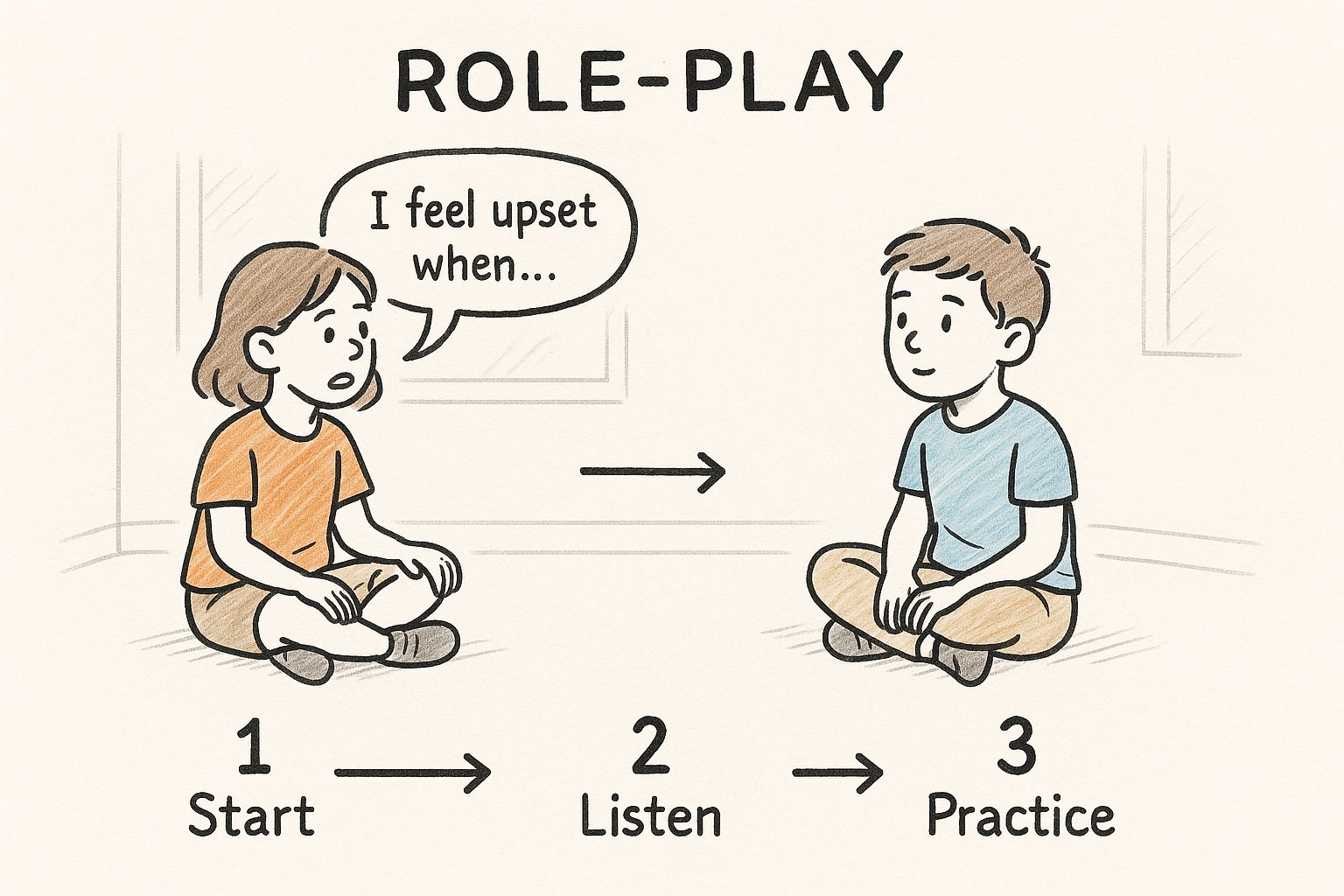
Confidence is a muscle that grows with practice. Teaching kids how to be assertive isn't about memorizing phrases; it’s about giving them a safe space to rehearse. Role-playing moves assertiveness from an idea into a concrete, usable skill.
Instead of waiting for a conflict on the playground, use low-stakes practice at home to build their communication reflexes. This hands-on approach is a core concept we explore in our guide on how children learn through play.
How to Role-Play Tonight (5-Minute Version)
You don't need a formal setup. Role-playing can be a quick, five-minute activity before bed. Start with a simple scenario your child might face.
- A friend wants to copy their homework.
- Someone cuts in front of them in line.
- A sibling takes their toy without asking.
You play the other person and let your child practice their response. A crucial scenario where assertiveness is essential is learning how to deal with peer pressure effectively.
The "I Feel..." Statement Formula
A simple but powerful tool for teaching assertiveness is the "I feel..." statement. It helps kids express their needs without blaming, which reduces defensiveness.
The formula is: I feel [emotion] when you [action] because [reason]. I need [request].
For example: "I feel frustrated when you take my LEGOs without asking because I was in the middle of building. I need you to ask me first."
This script gives kids a reliable structure to fall back on when they feel flustered. It moves the focus from "You are bad" to "This is how your action affects me."
Compare Communication Styles
Show your child what the alternatives look like. Use a simple scenario and act out the three main responses: passive, aggressive, and assertive. This visual contrast helps them see why being assertive is effective.
| Scenario | Passive Response | Aggressive Response | Assertive Response |
|---|---|---|---|
| A friend wants to play a game your child dislikes. | "Okay, I guess we can play that." (while feeling unhappy) | "That game is stupid! I'm not playing!" (and walking away angry) | "I'm not in the mood for that game right now. How about we play soccer instead?" |
Acting these out helps your child feel the difference and see the likely outcome of each approach.
Mastering How to Say No Respectfully
For many kids, saying "no" feels terrifying. They worry about hurting a friend's feelings or being seen as mean. A huge part of teaching kids to be assertive is reframing "no" from a word of rejection into an act of self-care. It's about setting boundaries firmly but kindly.
This crucial skill empowers them to protect their time, energy, and feelings without damaging friendships.
Scripts for Tough Situations
Give your kids a few phrases to practice so saying "no" feels less daunting. Here are a few options you can role-play together:
- The Simple No: "No, thank you. I'm not really feeling up for that right now."
- The "No, But..." Alternative: "I don’t want to play that game, but how about we build a fort instead?"
- The Confident Pass: "I'm going to pass on that, but thanks for asking."
The goal isn't just to say no; it's to communicate a boundary while protecting the relationship. This helps kids see assertiveness as a tool for connection, not conflict.
The Broken Record Technique
Sometimes, a friend won't take no for an answer. For those moments, the "broken record" technique is a game-changer. It’s about calmly repeating the same boundary without getting sucked into an argument.
Imagine a friend keeps begging to borrow a new toy. Your child could say, "I'm not sharing my new LEGO set today." If the friend asks again, the response stays the same: "Like I said, I'm not sharing my new LEGO set today." This teaches them to hold their ground without escalating the situation.
The impact of this training is massive. One study found that after assertiveness training, the percentage of highly assertive students shot up from just 16% to 70%. It also led to a significant drop in anxiety. You can dive deeper into the findings on assertiveness training here.
Turning Practice into Real-World Agency
This is where the practice pays off. The goal isn't winning a debate over a cookie. It's watching your child confidently steer their own learning and social world. At-home role-playing blossoms into real-world agency.
Your child shifts from being a passive consumer to an active architect of their experiences. When a kid has the confidence to voice an idea for a project, ask for help, or negotiate with a sibling, they aren't just being assertive. They're exercising agency.
From Voice to Action
Think of assertiveness as the engine that turns a flicker of interest into real impact. A child might have a brilliant idea for a weekend project, but it’s their ability to communicate that gets the family on board and brings the vision to life.
Start from any spark—dinosaurs, video editing, chess tactics. Kubrio drafts right-sized quests (10, 20, or 45 minutes) and guides you on what feedback to give. Finished work saves to a portfolio so growth is simple to see and share.
Assertiveness empowers them to:
- Negotiate ideas: "Dad, what if we made a stop-motion movie about the T-Rex first?"
- Give constructive feedback: "I like the color you chose, but maybe we can make the horns bigger in v2?"
- Advocate for their needs: "Mom, can we get some green clay? It would make the diorama look more real."
When we praise the act of self-advocacy, we celebrate the process, not just the product. It sends a powerful message: Your voice makes things happen.
Research shows a strong positive link between assertiveness and academic motivation. Students who felt more comfortable being assertive were more driven to hit their goals. You can see the data in the full study on the connection between assertiveness and student motivation.
Reinforcing Agency with Specific Praise
Your feedback makes these lessons stick. A generic "good job" is forgettable. To reinforce the behavior, get specific and praise the assertive action you witnessed.
Our article explains why feedback transforms your child into a confident learner.
Try these parent scripts to celebrate the process:
- "I loved how clearly you explained your idea. It helped me see exactly what you were imagining."
- "Show me your favorite mistake and what it taught you."
- "That was great how you asked for a turn instead of just getting upset. You handled that really well."
Each statement reinforces that their voice is their most powerful tool. This is the heart of agency.
FAQ: Teaching Kids to Be Assertive
Here are answers to common questions parents have on this journey.
What's the difference between assertive and aggressive?
A: Assertiveness is built on mutual respect. It’s honoring your needs while also honoring the other person's. Aggression is about winning at all costs, often by yelling or blaming. Assertive is "I feel...", while aggressive is "You are...".
How can I help my shy child become more assertive?
A: Start small with low-stakes role-playing at home, maybe with stuffed animals. Model assertive behavior yourself in everyday situations. Praise tiny steps and effort, like making eye contact when they say thank you. Small wins build big courage.
What is a good age to start teaching assertiveness?
A: You can start with toddlers by naming their feelings and giving simple choices. Preschoolers (4-5) can learn simple boundary phrases like "Stop, I don't like that." School-aged kids (6-13) are ready for role-playing with "I feel..." statements and more complex scenarios.
What if my child tries being assertive and gets a negative reaction?
A: This is a key learning moment for resilience. First, validate their feelings: "That sounds so frustrating. You used a great 'I feel' statement, and they still didn't listen." Then, problem-solve together. Ask, "What's one tiny thing we could try differently next time?" This puts them back in the driver's seat.