
A Parent's Guide to Self-Directed Learning
Self-directed learning isn't a complex theory from an education textbook. It’s what happens when your child is in the driver’s seat, turning their curiosity into projects they can build, test, and share.
This is a world away from the passive, one-size-fits-all model of endless worksheets or quiz apps that produce nothing. Instead of just consuming information, your child becomes the creator of their learning journey—building the agency they need for an AI-shaped future.
What Self-Directed Learning Looks Like at Home
Think of your child as the founder of their own "learning startup." They get to call the shots, test out ideas, and learn from what works—and just as importantly, what doesn't.
This doesn't mean you leave them alone. It’s about changing your role. You shift from being a teacher with all the answers to a coach who asks great questions. This small change in mindset is everything. It prepares them for a future where knowing how to learn is more valuable than memorizing facts.
 Hand-drawn neighborhood map, v2 — added symbols and a key after testing the route.
This approach is the opposite of passive learning. When kids only fill in blanks or tap through apps, they’re trained to wait for instructions. Self-directed learning builds their problem-solving and creative-thinking muscles, giving them a sense of agency that lasts a lifetime.
The Shift Towards Learner Autonomy
This desire for more control isn't just for kids. In 2023, employees spent 72% more time on learning they chose for themselves compared to company-assigned training. It’s a clear signal that people want to direct their own growth.
The same principle is powerful at home. When your child decides to create a stop-motion video with their Lego figures, they’re practicing real-world skills:
- Project Management: They dream up a story, build sets, and sequence shots.
- Problem-Solving: They figure out how to keep the camera steady or make a character fly.
- Grit: They learn to push through taking hundreds of individual photos.
- Reflection: They watch their first draft and decide what to improve for the next version.
Self-directed learning is a core part of a broader educational philosophy. To see how it fits into the bigger picture, you can explore the principles of student-centered learning.
Why Agency Matters More Than Ever
In a world where AI can answer almost any question, the real superpower is the ability to ask great questions and solve problems that don't have known answers. This is the skill set self-directed learning builds, and it all comes down to one word: agency.
Agency is a child’s capacity to make choices and take action to shape their own world. It’s the belief that they are in control.
By encouraging your child to lead small projects today, you're giving them the confidence and tools to take on bigger challenges later. It becomes less about knowing everything and more about having the courage to figure anything out.
Building Your Child’s Agency with Three Core Pillars
"Agency" can feel like a big concept. But at home, it boils down to three simple pillars: Choice, Challenge, and Reflection. When you master these, you turn everyday moments into powerful learning opportunities, helping your child shift from a passive consumer to an active creator.

This isn't about a massive overhaul of your parenting style. It’s about small, consistent shifts that build your child’s confidence and independence, one project at a time.
Let Them Steer with Choice
Choice is the bedrock of agency. When kids have a say in what they do, their motivation skyrockets. This isn't a free-for-all; it's about offering structured options that empower them to take the lead.
Start small. Instead of prescribing an activity, frame it as a decision they can own.
Parent Scripts for Offering Choice:
- “We have time for a project. Would you rather build a fort or design a new character for your favorite game?”
- “You want to make a map. Do you think it’s better to draw it by hand or try building it online?”
- “This stop-motion video is amazing! Should we have a family movie night or send it to Grandma?”
Giving them small decisions builds the muscle for bigger ones. To take this a step further, understanding methods like inquiry-based learning can put your child's curiosity in the driver's seat.
Find the Sweet Spot with Challenge
Next up is Challenge. The goal is to find that "Goldilocks" zone—a task that’s not so easy it’s boring, but not so hard it’s frustrating. Frame projects as moving from a first draft (v1) to a second, better version (v2).
"I love that my daughter isn't afraid to start over now. She'll build a v1, test it, and immediately start talking about what to change for v2. That's a huge shift from getting upset when things weren't perfect on the first try." — Sarah, Austin
This approach teaches resilience and shows that mistakes are just data for the next attempt. It shifts the focus from perfection to progress, a vital skill for tackling anything complex.
Kubrio is a family-driven learning platform that uses AI to turn your child’s interests into step-by-step quests with feedback and a living portfolio.
Deepen Learning with Reflection
Finally, Reflection is what cements the learning. It’s the crucial pause where your child thinks about how they did something, not just what they did.
Use open-ended questions that prompt them to analyze their own process.
Powerful Reflection Prompts:
- “Show me the part that was the hardest. How did you figure it out?”
- “What changed between your first idea and the final version?”
- “If you did this again, what’s one thing you would do differently?”
- “Where did you get stuck, and what helped you get unstuck?”
These questions don't have right or wrong answers. They encourage your child to become aware of their own thinking—a skill that will power their curiosity for years.
A 7-Step Recipe for Self-Directed Learning at Home
Here's a framework that turns your child's curiosity into confidence. Think of it as a seven-step recipe, moving from an initial spark to a finished project they can be proud of. It’s flexible enough for a Tuesday night but structured enough to build real skills.
This isn't about rigid lesson plans. It’s a simple, repeatable process that puts your child in the driver's seat. It uses short time boxes and simple guides so you can try it tonight.
This process mirrors how innovative companies work: they start with a vision, build a prototype, test it, learn, and improve. Your child becomes the CEO of their own learning project.
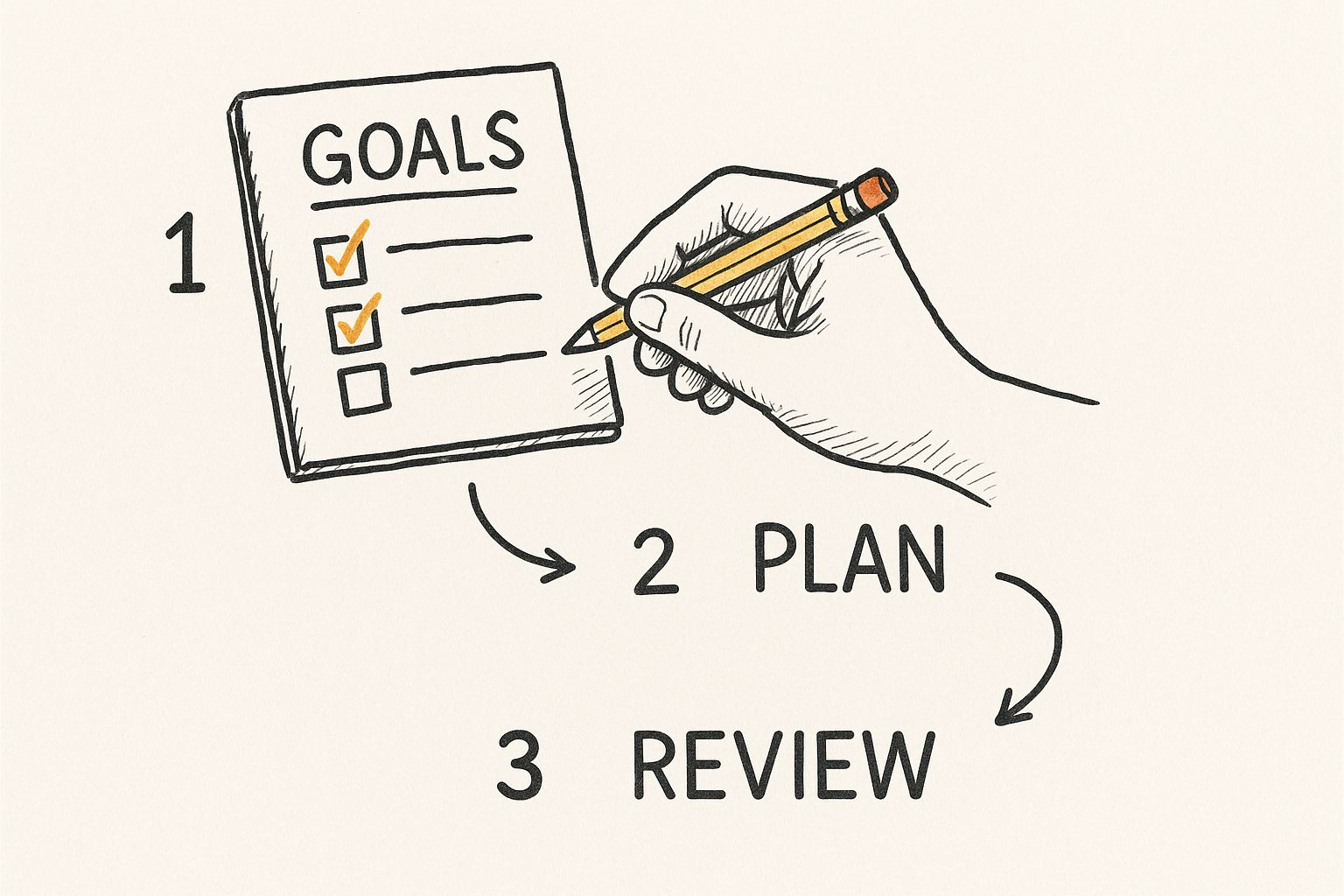
It's a simple loop: set a goal, take action, and review what happened. Each cycle builds on the last, fueling your child's sense of agency and showing them that progress comes from trying things, not just getting them right the first time.
Step 1: Pick The Spark
Start with what they’re already excited about. Frame it as a fun challenge. "You love building with Legos—let's see if we can make a car that zooms down this ramp!" This turns their curiosity into a clear goal.
Step 2: Name The Skill
Zero in on one specific skill you want to help them stretch, like systems thinking or creativity. In our Lego car example, the skill is systems thinking—figuring out how wheels, axles, and weight work together. Naming the skill helps your child see their own growth.
Step 3: Set Constraints
Constraints aren't about limiting creativity; they’re about focusing it. Give them a time box—maybe 10, 20, or 45 minutes—and a specific list of materials. These real-world limits teach them to problem-solve within a realistic scope.
A good set of constraints might look like this:
- Time: 20 minutes to build and test.
- Materials: Lego pieces, a ramp, tape.
- Safety: Adult nearby for supervision.
- No-kit option: Draw the car design instead of building it.
This is where self-directed learning shines, especially when compared to passive, one-size-fits-all learning. One approach builds agency; the other leads to consumption.
| Aspect | Self-Directed Learning (Agency-First) | Passive Learning (Worksheet Model) |
|---|---|---|
| Control | Child leads the topic and process, making key decisions. | Follows pre-set worksheets and quizzes with one right answer. |
| Process | A cycle of exploring, iterating, testing, and improving. | A one-off task with no opportunity to revise or learn from mistakes. |
| Engagement | Hands-on creation of something real and meaningful to them. | Passive consumption of content, like filling in blanks. |
Step 4: Draft Action Steps
Break the project into a few clear, one-line steps. This makes the challenge feel manageable.
For the Lego car, the plan might be:
- Sketch a quick outline of the car.
- Build the first version (v1).
- Test the car on the ramp.
- Decide what changes might make it faster.
- Build version two (v2) with new ideas.
Each step is a small victory, keeping frustration low and engagement high.
Step 5: Guide Feedback
After they’ve tested their first version (v1), pause for reflection, not judgment. Ask open-ended questions that get them thinking about their process.
- “What worked really well in that first test?”
- “Where did you get stuck, and how did you unstick it?”
You can also offer specific, process-focused praise.
“I love how you adjusted the axle placement for a smoother roll. That was a great observation.”
Step 6: Share The Work
Showcasing what they’ve made builds pride and cements their learning. Keep it simple and fun.
- Family Demo: Host a five-minute "show-and-tell."
- Photo: Snap pictures of v1 and v2 side by side.
- Video Clip: Record a quick 20-second demo for grandparents.
Sharing their work validates their effort, making them eager for the next challenge.
Step 7: Reflect and Capture Insight
End with a couple of reflection prompts and a key takeaway. This helps them internalize what they learned.
- "Which part of your design was the most surprising?"
- "If you were going to build a v3, what's one thing you'd change?"
Their answer becomes a powerful insight. Jotting it down creates a living portfolio of their learning journey and gives them a starting point for future projects.
How Kubrio Simplifies This Recipe
This seven-step recipe is the engine that powers Kubrio. Start from any spark—dinosaurs, video editing, chess tactics. Kubrio drafts right-sized quests (10, 20, or 45 minutes) and guides you on what feedback to give. Finished work saves to a portfolio so growth is simple to see and share.
This framework empowers you to become a confident learning designer for your child. You set the stage, and your child leads the journey—building skills, creating amazing things, and reflecting on every step.
Real-World Self-Directed Projects for Kids
Theory is great, but the magic happens when kids get their hands on a project. The goal isn't a flawless product; it's the messy, wonderful process of building, testing, and reflecting that wires their brains for future challenges.
Below are practical project ideas for kids aged 6-13. Each can be a quick 10-minute spark or a more involved 45-minute deep dive.
Explore and Document Your World
These projects encourage kids to become sharp observers, using research and communication skills to share what they discover.
Project Idea: Map Your Neighborhood This classic activity is a powerful introduction to systems thinking. It transforms a walk into an act of discovery and design.
- Target Skill: Systems Thinking (understanding how parts of a whole connect).
- Time: 10 min (sketch a map from memory), 20 min (walk one block and draw it), or 45 min (walk a larger route, then create a detailed map with a key).
- Materials: Paper, pencils, markers. Optional: clipboard, compass app.
- Safety: An adult should always accompany the child on their walk.
- No-Kit Option: Use a free online drawing tool to create a digital map of a favorite fictional world.
The desire to take charge of one's own education is exploding. In 2021, one online learning platform saw over 17 million new learners in the US and 13.6 million in India, a massive shift toward self-directed education.
Build and Test Your Ideas
Building projects are fantastic for developing grit and an iterative mindset. Kids learn firsthand that the first version is rarely the final one.
Project Idea: The Unsinkable Boat Challenge The mission: design and build a small boat that can hold the most weight (like coins or small rocks) before it sinks.
- Target Skill: Grit (persisting through trial and error).
- Time: 10 min (build one boat), 20 min (build v1, test it, and build v2), or 45 min (experiment with three different materials and document which worked best).
- Materials: Aluminum foil, craft sticks, tape, a basin of water, items for weight.
- Safety: Supervise around water and be ready for small spills.
- No-Kit Option: Draw three different boat designs and write a sentence explaining why one would be the strongest.
Create and Share Your Stories
Creative projects help kids develop powerful communication skills. They learn to organize their thoughts and present them in a way that connects with an audience.
Project Idea: A Stop-Motion Animation Short Using toys and a phone camera, your child can bring their own story to life. This project is a brilliant exercise in patience, planning, and storytelling.
- Target Skill: Communication (telling a story visually).
- Time: 10 min (create a 3-second animation of one object), 20 min (create a 5-second story with two characters), or 45 min (plan a 10-second story with a beginning, middle, and end, then add sounds).
- Materials: Smartphone or tablet, a stop-motion app, toys or clay figures.
- Safety: Make sure the device is secure and won't fall over.
- No-Kit Option: Create a three-panel comic strip on paper that tells a complete story without words.
These examples show how easily you can weave the principles of project-based learning into your life at home in a way that feels natural and fun.
Troubleshooting Common Roadblocks
Even the most exciting projects hit a snag. Resist the urge to swoop in with the solution. Instead, use these moments as coaching opportunities.
| If Your Child Says... | Try This Coaching Response |
|---|---|
| "I'm stuck. I don't know what to do next." | "Let's look at your plan. What was the last step you finished? What's a tiny next move we could try?" |
| "This is too hard. I can't do it." | "It looks challenging. What's the hardest part? Can we break it into a smaller piece?" |
| "I'm bored with this now." | "That's okay. Let's put it aside. What's one thing you learned from what you've done so far?" |
| "It didn't work. It's ruined." | "Awesome! That's a great v1. What did this test teach you? What will you change for v2?" |
Your role isn't to prevent frustration. It's to help your child see it as a normal part of the creative process. By guiding them with questions, you empower them to find their own way forward.
Your Role as a Coach, Not a Content Expert
Here’s a big hurdle for parents: the fear that you don’t know enough. "How can I guide my child's project on robotics if I've never built one?"
It's a fair question, but it comes from the legacy school model, where the adult is supposed to have all the answers.
Your job is different. You're not the teacher. You're the coach and number one fan. Your expertise isn’t in Python or cartography; it’s in knowing your child. Your superpower is your ability to ask great questions, encourage them when they get stuck, and celebrate their process.
This shift is incredibly freeing. It takes the pressure off you and puts the focus where it belongs: on your child's growing ability to find their own answers and own their learning.
From Inspector to Collaborator
As a coach, your job is to be a curious collaborator, not an inspector checking for right answers. You’re there to support their thinking, not police it.
This means changing how you talk about their work. Instead of spotting what's wrong, you ask questions that help them discover things for themselves.
Parent Scripts for Coaching:
- Instead of, "That's not right," try: "That's an interesting approach. Walk me through how you got there."
- Instead of a generic, "Good job," try: "I love how you tweaked your plan after the first version didn't work."
- When frustration hits, ask: "Show me your favorite mistake and what it taught you."
These small shifts in language are huge. They build resilience and teach your child that getting stuck is a normal part of the process. For more practical insights, see our guide on formative vs summative feedback.
Framing Failure as Iteration
One of your most important jobs is to help your child build a healthy relationship with failure. In self-directed learning, there are no real failures—only iterations. A Lego car that falls apart isn't a failed project; it's version one (v1). The data gathered from that "failure" is what they need to build a stronger version two (v2).
"My son used to crumble when his drawings didn't look 'real.' Now he calls his first attempt a 'rough draft' and immediately starts talking about what he'll add in the next one. It's a total game-changer for his confidence." — Maria, Denver
This mindset is everything. It separates their self-worth from the outcome of a single attempt and connects it to their willingness to try again. When you celebrate the process of iteration, you’re building the grit that will serve them long after the project is done.
If you like project-based learning but want it doable at home, Kubrio handles the planning and feedback so you can focus on building and reflecting together.
Making Progress Visible with a Living Portfolio
When your child finishes a project, how do you capture that win? Grades and test scores from the legacy school model offer a flat snapshot. They don't tell the real story of their learning journey: the spark, the frustration, the problem-solving, and the growth from one attempt to the next.
This is where a living portfolio changes everything. It's a dynamic record of your child’s progress that shows not just the final product, but the entire process. It makes learning real and tangible.
The Story of Their Growth
A portfolio answers the biggest questions: Is my child actually learning? How can I see their progress? Instead of a single grade, you witness the evolution of their skills over time.
Imagine comparing their first hand-drawn map (v1) to their fourth version (v4). The new one has a detailed key, a compass rose, and notes from testing the route. That visual timeline is powerful, undeniable proof of their growing abilities. It tells a rich story of iteration.
This is why documenting projects is so essential. Our guide on creating a digital portfolio for students gives you practical steps to get started.
"Seeing all her projects in one place was an eye-opener. The portfolio showed us how her initial interest in drawing comics evolved into learning about storytelling and even basic animation. It's a real confidence booster for her and for us." — Ben, Los Angeles
How to Create a Simple Portfolio Tonight
You don't need a complicated system. A living portfolio can be a shared photo album or a physical binder. The goal is to create a space that celebrates the journey.
- Snap a Photo: Take a picture of what they finished. If they made a few versions, capture them side-by-side.
- Add a Caption: Write one sentence describing the skill they practiced. “Neighborhood map v2 — added symbols and a key after testing the route.”
- Include Their Reflection: Ask them, “What was the biggest thing you learned?” and jot down their answer.
This simple habit takes less than five minutes but builds a priceless record of their learning. It shifts the focus from "what did you get?" to "what did you build and learn?" This skill of autonomous learning is vital. Even at the university level, the shift to online tools has been shown to improve students’ ability to manage their own learning. You can learn more by reading the full research on student learning autonomy.
FAQ: Common Questions About Self-Directed Learning
Stepping into self-directed learning naturally brings up a few questions. Let's tackle the most common ones we hear from parents.
How do I start if my child isn't motivated? Start where they are, with whatever sparks a flicker of interest—even if it's a video game. Use that curiosity as a launchpad. Ask them to sketch a new character or design a different final level on paper. These small, low-stakes quests feel like play but build momentum and agency.
What if my child only wants more screen time? The goal isn't to fight screen time, but to change it from passive consumption to active creation. Challenge them to create something with the screen. Can they make a stop-motion movie with a phone? Design a new world for their favorite game? Screens are powerful tools when used to build, design, and create tangible things.
How much time does this take if I'm busy? Self-directed learning thrives in small pockets of time. A 10-minute "micro-project" can be a huge win. A 20-minute project where a child improves a first draft (v1) to a second (v2) delivers far more value than an hour of zoning out. It’s about consistency, not duration.
How can I be sure they are learning important skills? This requires a shift from tracking memorized facts to observing the growth of process skills like planning, problem-solving, and grit. The best evidence is a living portfolio. When you can see their first hand-drawn map next to their third version, you have undeniable proof of growth. You can see their thinking evolve.