
How do I get my kid to write?
Most 'reluctant writers' aren't short on ability — they're short on a reason. School writing is prompted, graded, and abandoned after one draft, which teaches a kid that writing is a chore performed for someone else. What actually gets a kid writing is a story that's theirs (a character they invented, not an assigned topic), a real audience waiting for the next part, and a structure finishable in one sitting so momentum survives contact with a blank page. Kubrio's Origin Stories is built around exactly that: your kid invents a character and plots the story, an AI Crew draws the panels to their direction, and a real issue publishes on a weekly cadence under their own pen name.
Most kids who say they hate writing aren't struggling with the skill — they're stuck with someone else's topic, no real audience, and a draft that gets graded once and forgotten. Fix those three things — give them a story that's theirs, a reader waiting for it, and a shape they can actually finish — and a surprising number of "reluctant writers" turn out to have plenty to say.
That reframe matters because it changes what you try first. If the problem were ability, you'd drill spelling and sentence structure. If the problem is motivation and mechanics getting in the way of ideas, you fix the setup instead — and that's a much faster, much less painful fix.
Why school writing trains kids to dread it
Three things quietly stack against a kid every time they sit down to write a school assignment:
- The topic isn't theirs. An assigned prompt asks a kid to perform interest in a subject they didn't pick, which is a different mental task than inventing something they actually care about.
- There's no real audience. A paper that one teacher reads once, grades, and hands back doesn't create the pull that "someone's going to read this" does. Writers of every age write better and more willingly for a reader they can picture.
- It's rarely finished, in the sense of "done and out in the world." A graded essay is closed, not published. A kid never gets the feeling of I made a whole thing and people saw it — the feeling that makes you want to make the next one.
None of that is a knock on teachers, who are usually managing thirty kids and a curriculum. It's just a mismatch between what school writing is structurally built to do (assess) and what actually builds a kid's love of writing (ownership, audience, finishing).
A framework that works before you touch a keyboard
You can run this with a notebook and zero apps. The order matters more than any individual step.
- Start with invention, not prose. Before a single sentence gets written, let your kid invent something — a character, a creature, a world — out loud or in a doodle. The instinct to write comes easier once there's something they want to say, not before.
- Separate the idea from the mechanics. Handwriting, spelling, and sentence construction are a different cognitive task from inventing a story, and for a lot of reluctant writers, the mechanics are the actual blocker. Let them talk it out, dictate it, or sketch it first, then worry about getting it onto the page.
- Give the story a shape that's finishable. A blank "write a story" prompt is intimidating; three beats — what's the setup, what goes wrong, how does it resolve — is not. A kid who can name those three things almost always has a finishable story.
- Build in a real audience. Even reading it aloud at dinner counts. A story that's going somewhere — to a sibling, a grandparent, or a public page — gets finished at a much higher rate than one that's going in a drawer.
- Make "done" a weekly habit, not a one-time event. A single finished story is nice; a series is what turns a kid into a writer. Weekly cadence beats one big push — it's how the identity "I'm someone who makes a comic every week" actually forms.
Run those five in order on any project — a notebook comic, a shared Google Doc, a bedtime story your kid tells you — and you'll get further than any worksheet.
Where AI genuinely helps a reluctant writer, and where it gets in the way
AI is a legitimate part of this conversation now, and it's worth being honest about both directions. A tool that writes the paragraph for your kid — finish this essay, generate this story — removes the exact practice that builds writing skill. The struggle of turning an idea into words on a page is the thing that's actually training the muscle; skip it and the muscle doesn't grow, no matter how good the output looks.
But AI that removes a different barrier — the drawing, the layout, the mechanical typing-out of dialogue — while leaving the invention, the plotting, and the editorial decisions to the kid is a different kind of tool entirely. The test is simple: does it hand your kid the finished thing, or does it clear the parts that aren't the actual skill you're trying to build?
How Kubrio's Origin Stories fits this framework
This is the exact reason Origin Stories exists as one of Kubrio's apps: it applies the five-step framework above, structurally, to a comic your kid actually publishes.
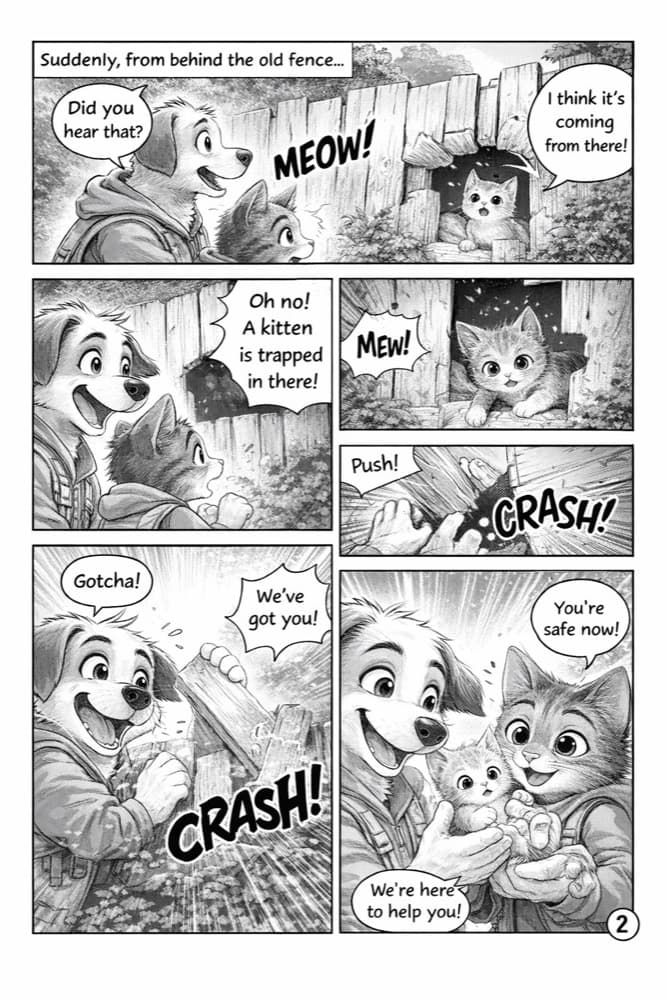
Your kid is editor-in-chief of their own comic series. They invent a character in words — the AI Crew sketches a character sheet, and your kid refines it ("more grumpy," "not like that") until it's genuinely theirs, and it carries through the whole series. Then they plot the issue: a story partner from the AI Crew asks questions until your kid can name the three beats — setup, trouble, payoff — and your kid locks the story. They pick a style once (manga, comic book, zine, or newspaper strip), and then they become editor over the panels: the Crew draws draft art and dialogue to their direction, and your kid redraws a panel, rewrites a line, or reorders pages until it lands. The Crew never overrides them — every panel is framed as "here's a draft, what do you want changed?"
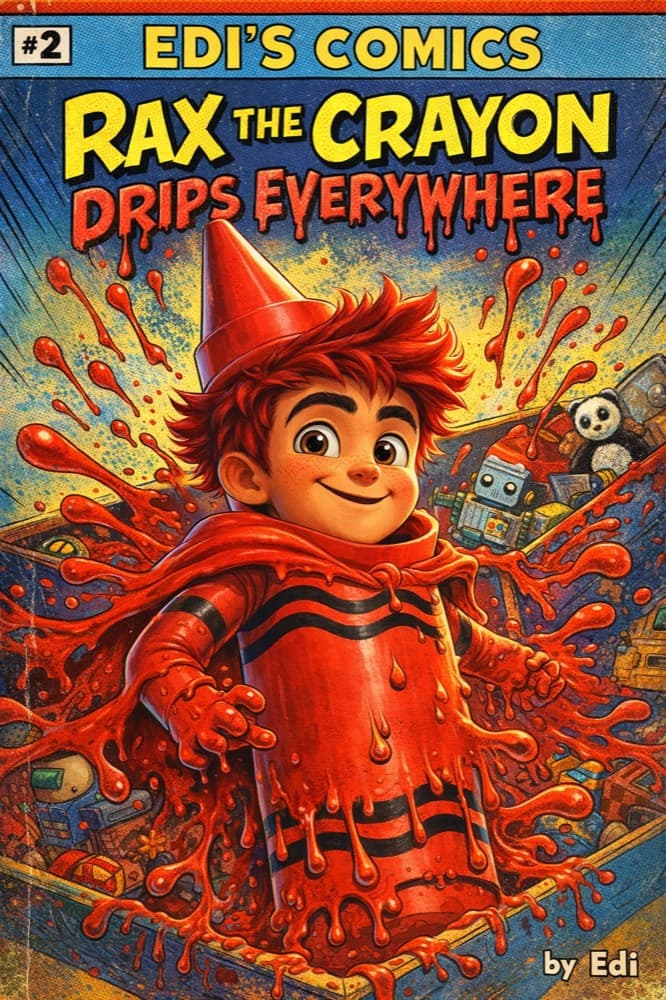
The first issue is designed to finish in a single sitting, often under an hour, so a kid who's never written anything for fun leaves with a published comic on day one — cover, pen name, issue number. After that, a new issue publishes on a weekly cadence, typically Friday night, which is the "weekly habit" piece of the framework built into the product rather than left to willpower. By month three, a kid can have a dozen issues and a world with its own rules — which is a very different outcome than a folder of abandoned first drafts.
Your kid doesn't need to know how to draw. The skill Origin Stories is actually building is authorship — plot, pacing, character, knowing when an ending lands — not drawing technique, so a kid who's blocked on handwriting or illustration isn't blocked on the story anymore.
What you see as a parent
Each published issue shows up in your kid's portfolio and in your weekly update from Claire, with a short note on what your kid actually did — which panels they redrew, how they landed the ending. You approve your kid's pen name before the first issue publishes. Your kid decides what's visible in the internal Kubrio Gallery, and whether an issue ever gets its own public page — see Sharing and privacy for exactly how that works.
A checklist you can run this week
- Does your kid have a story idea that's genuinely theirs, or an assigned topic?
- Have they invented the character or world before being asked to write prose?
- Is there a real reader waiting — a sibling, you, an audience — or does the draft go straight in a drawer?
- Is the shape finishable in one sitting (three beats: setup, trouble, payoff), or open-ended and intimidating?
- Is there a next one coming, or does this end when the assignment is graded?
If most of those are "no," that's the actual gap — not ability, and not enough writing practice.
Frequently asked questions
My kid says they have "nothing to write about." What do I do?
Start with invention, not writing. Ask about a character or creature they'd want to exist, not a topic. Once there's a character they care about, the story almost always follows — the blank page was never really the problem.
Is it bad for my kid to use AI to help with writing?
It depends entirely on what the AI does. An AI that writes the sentences for your kid skips the practice that builds the skill. An AI that clears mechanical barriers — drawing, layout — while your kid invents the character, plots the beats, and edits the result is a different, much more defensible use.
My kid loves drawing but hates writing sentences. Are those related?
They're more connected than they look. A lot of "hates writing" is really "hates the mechanics of prose" while the underlying instinct — invent a character, tell a story — is intact. A comic format, where the story is told through panels and dialogue rather than paragraphs, often unlocks kids who stall out on a blank page.
How long before my kid finishes something?
With the right setup, a first finished piece can happen in one sitting — under an hour, in Origin Stories' case. The point of a finishable structure (three beats, one sitting) is exactly to get a kid to "done" fast, because finishing is what makes them want to start the next one.
Does my kid need to already like reading to get into writing?
It helps but isn't required. Plenty of kids who don't reach for books on their own light up the moment the story is one they're inventing rather than consuming. Writing and reading reinforce each other over time, but you don't need one before the other.
What age is Origin Stories built for?
Roughly 6 to 13, and it fits especially well with kids who already fill notebooks with characters or read graphic novels, even if they've never called themselves "writers."
Can my kid do this without knowing how to draw?
Yes. Your kid describes characters and scenes in words, and the AI Crew draws them. The skill being built is authorship, not illustration.
Is this the same as an AI writing the story for my kid?
No — the Crew never overrides your kid's decisions. It draws to their direction and asks questions during plotting, but the character, the story beats, the edits, and the ending are your kid's calls, every time. --- Want to see your kid become editor-in-chief of their own comic? [Start your family account](https://app.kubrio.com/start).