
Halloween art projects for kids: make one real thing, not forty crafts
By Kubrio Editorial Team. Reviewed by Vlad Stan, founder of Kubrio.
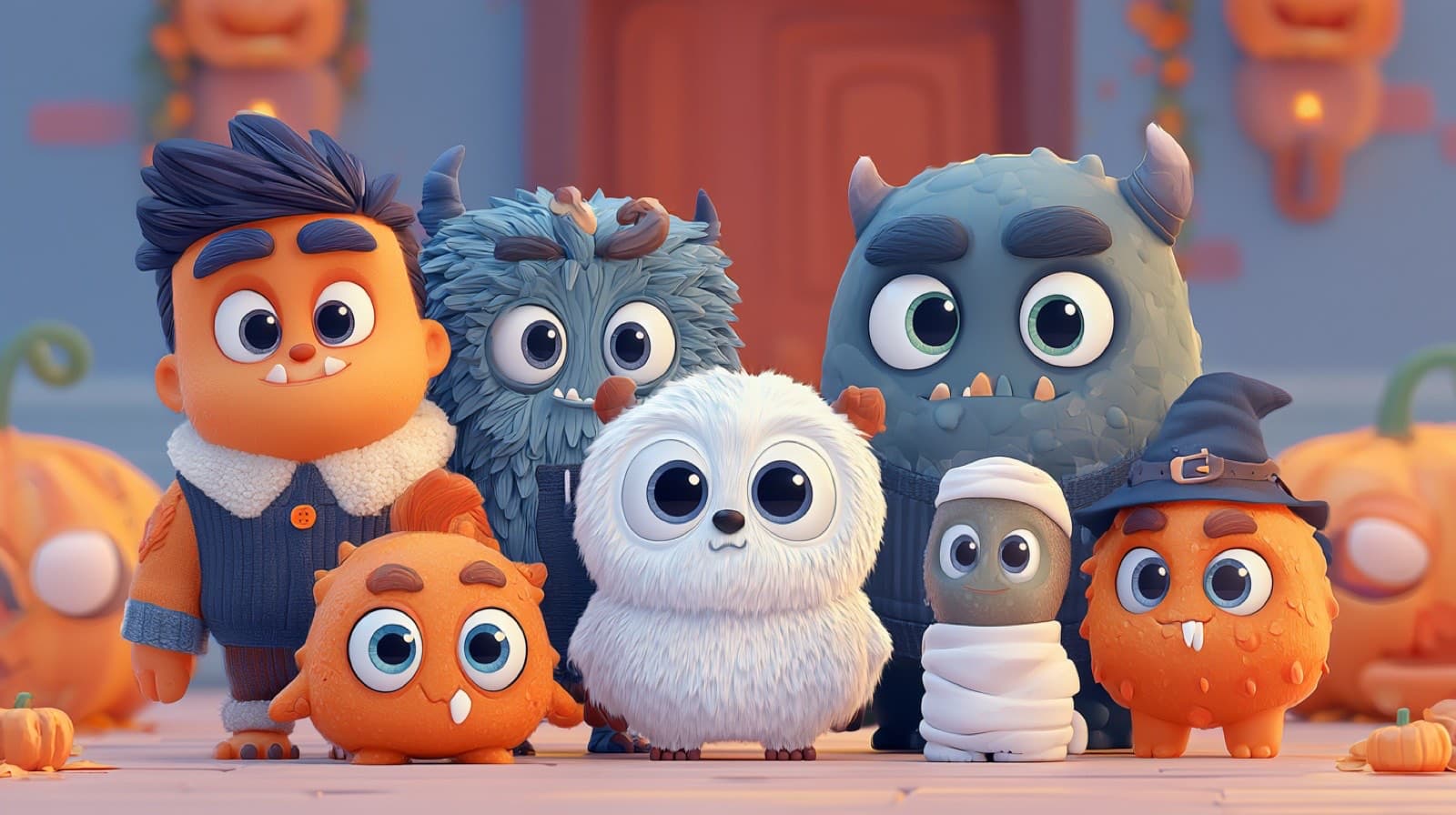
The best Halloween art project for your kid is one project, not forty. Search for Halloween projects for kids and you get menus of 36, 57, or 75 crafts, each ending on a wall. Run one instead, across three sittings, and it ends as something someone outside your house watches, reads, or hears. Taranu and colleagues (2025) surveyed 1,600 parents: 93% of children were reported to enjoy at least one scary activity on purpose. October is the month to use that. If your kid first needs something to draw, Easy, cute Halloween drawings for kids ranks 18 subjects by age and gives the five rules that make a drawing cute; this page is about what the drawings become.
Why do forty crafts leave nothing behind?
Because nobody outside the house sees them. Papert and Harel argued in Situating Constructionism (1991) that learning goes best when the maker is "consciously engaged in constructing a public entity." A paper-plate ghost is not a public entity. A two-minute film your grandmother watches end to end is.
There are two kinds of projects for kids. The first kind ends on the fridge door. The second kind ends as a real thing other kids can read, watch, or play. Kubrio makes the second kind. Kids make them by directing the same AI the pros use. Every project in Kubrio's studios, Animation, Game, Comic, and Robotics, has that shape.
Why are monsters good for your kid?
Because chosen fear is something most children already want. Andersen and colleagues (2020) monitored 110 haunted-house visitors aged 12 to 57 and found enjoyment followed an inverted U: too little fear is boring, too much stops being fun. The fear has to be chosen and controllable, and only your kid knows where the dial sits.
The second reason is what they draw. Drake and Winner (2013) had children aged 6 to 8 and 10 to 12 draw after a sadness induction, and mood lifted most when a child freely constructed their own picture. Where children copied someone else's drawing, the effect disappeared. Copying is what almost every Halloween page asks for: here is the witch, here are the nine steps. Inventing a monster is a different task.
If your kid says they can't draw a monster, Kubrio's free Halloween drawing guides cover a pumpkin, a ghost, a bat, a witch, a zombie, and 13 more, six steps each, and new subjects land every Monday. For the cute version of each one, and the twists that make a copied drawing their own, read Easy, cute Halloween drawings for kids.
Why start with a constraint, not a blank page?
Because the blank page is the harder assignment. Haught-Tromp (2017) had people write two-line greeting-card rhymes, and blind judges rated the rhymes written under an arbitrary constraint as more creative than the free ones: 5.18 against 4.29 on a ten-point scale. The paper is named for the fifty-word bet that produced Green Eggs and Ham.
Here are four Halloween drawing ideas that work as constraints. Give your kid one.
- A monster who is afraid of the dark.
- A ghost who can't stop sneezing.
- A monster that is very polite and very hungry.
- A monster that used to be somebody's pet.
Which four Halloween art projects end as a real thing?
Here are four Halloween art ideas. Your kid picks one. Each runs three sittings, starts on paper, and ends in front of an audience.
The monster movie
One monster on paper becomes a 30-second animated short. Ages 7 to 13.
- Design it (45 min). The monster drawn three times on one page: front, side, in motion. That model sheet keeps it identical in every frame. Ask: "What is it afraid of?"
- Six panels (45 min). Fold a sheet into six boxes: normal place, wants something, tries, goes wrong, real problem, ending. Ask: "What goes wrong in the middle?"
- Make it move (60 min). Stop-motion on a phone, or an animation tool fed the model sheet and the six panels. Ask: "Which shot do you want to redo?"
Don't take over the software. Premiere with the lights off and everyone sitting down.
Kids make the same kind of thing in Animation Studio's Make a monster movie: one monster drawn on paper, a three-scene story your kid tells and fixes, one line per character, and a 45-second film that ends with a poster and a premiere. For an eight-scene version over a week, there's Make a ghost story. To plan the film first, the free course How to make a monster walks through it in short films.
The spooky comic
A 4 to 8 page comic about the monster. Ages 8 to 13, or 6 to 7 with bigger panels.
- Cast one bad night (40 min). Draw two characters side by side, so their sizes settle early. One sentence: "On the night that ___, ___ has to ___." Ask: "Who is this happening to?"
- Thumbnails (40 min). Two comic pages per sheet, small and fast. The scary thing gets the biggest panel, and gets it late. Ask: "Where does the reader first get scared?"
- Ink and bind (60 min). Redraw full size, bubbles before the words, a cover with a title and "by ___". Ask: "Shall I read it out loud?"
Don't correct spelling on the page. Premiere it by leaving the copy on the kitchen table to be found.
Kids make the same kind of thing in Comic Studio's A Monster Moved Into My Closet: your kid draws the opening, the middle, and the ending on paper and gets an 8-page comic with their name on the cover. The free course How to make a comic book covers panels and speech bubbles first.
The monster field guide
A 6 to 10 page illustrated guide, one monster per page. Ages 6 to 11, the most forgiving of the four.
- Six monsters, fast (40 min). Six drawings, six minutes each, no erasing. The sixth is always stranger than the first. Ask: "Which one do you want to know more about?"
- Fill in the fields (40 min). Redraw each one bigger, one per page, with identical fields: Name, Habitat, Diet, Fear rating, Weakness, First sighting. Ask: "What beats it?"
- Cover and contents (40 min). A title, "compiled by ___, October 2026", page numbers, and an "unconfirmed sightings" page at the back. Ask: "Which one is real?"
Don't correct a contradiction between two entries. Premiere it beside the candy bowl, and the measure is that somebody else writes in the back.
Kids who want the field guide's monsters to star in something can take one into Comic Studio's A Monster Moved Into My Closet, a comic about a monster your kid draws.
The midnight broadcast
A two-minute scary story, recorded like a radio show. Ages 8 to 13, best for a kid who resists drawing.
- Write 300 words (40 min). An ordinary place named precisely, one thing slightly wrong, an explanation that makes it worse, a last line of five words. Ask: "What's the last line?"
- Sound and rehearsal (30 min). Mark the script: a slash for a pause, an underline for what slows down, capitals where the volume drops. Ask: "Where do you go quiet?"
- Record (30 min). A voice memo app, three takes, keep one. Under a duvet is a good recording booth. Ask: "Which take?" Your kid decides that one.
Don't perform it for them first. Your read becomes the one they imitate. Premiere it in the dark, before the candy.
The same skills carry into a film: in Animation Studio's Make a ghost story, your kid gives each character one line, typed or said out loud. For the voice itself, the course How to voice act in the Kubrio app shows how to find a voice for each character and show a feeling with it.
What do you do while your kid makes it?
You are the audience and the question-asker, and you are not the art director. Hetland, Winner and colleagues videotaped 38 visual-arts classes and named the eight Studio Habits of Mind that serious art teaching builds. Three are what three sittings demand: Envision is the model sheet, Engage and Persist is coming back on day two, and Reflect is choosing which take to keep. Twenty minutes with a glue stick exercises none of them.
The questions inside each project are the whole job. Ask one per sitting, then stop talking. Don't fix the drawing, don't supply the ending, and don't say a monster can't have that.
What does a Halloween art project not do?
It does not raise your kid's math grade. The OECD report Art for Art's Sake? by Winner, Goldstein and Vincent-Lancrin (2013) found no demonstrated causal effect of arts education on general academic achievement or general creativity, and no empirical study at all on critical thinking. Expertise in an art form builds "creative abilities in that art form", and that new creativity "does not spill over into other domains."
The honest promise is narrower. A kid who designs monsters gets better at designing monsters, at close observation, and at finishing. Kubrio treats finishing as the event: your kid premieres every finished film, and an October monster film is exactly the kind of thing worth premiering.
What to do at home this week
- Pick one of the four projects with your kid, out loud. Say "project", not "craft".
- Put the premiere on the calendar before anything is drawn.
- Give one constraint from the list, and not "draw anything you want".
- Book three sittings of 40 to 60 minutes. Two on paper, one to finish.
- Ask one question per sitting, then be quiet.
- Hold the premiere with the lights off, and invite someone who lives elsewhere.
Ingenious projects that inspire kids to make things — until they find the thing only they could make.
If your kid picks the monster movie, start with Make a monster movie: a monster drawn on paper stars in a 45-second animated film, made in one sitting. Or see the studios, then start here.
FAQ
What ages are these Halloween art projects for? Kids 6 to 13. The field guide suits the younger end, because a kid who resists inventing a plot will happily invent a taxonomy.
My kid says they can't draw. Does that rule these out? No. The broadcast is voice only, and the field guide rewards speed over polish. For a warm-up, the free Halloween drawing guides cover a ghost, a bat, and a black cat in six steps each.
Shouldn't that time go to schoolwork? Drawing is not the soft option. Fernandes, Wammes and Meade (2018) summarize experiments in which drawing material beat writing it out, visualization, semantic elaboration, and tracing.
My kid doesn't like scary things. Should we skip the monsters? Follow your kid. The research is about fear that is chosen and controllable, and too much stops being fun. A polite, hungry monster carries the project with none of the dread.