
Can my kid make a video game without coding? Start on paper
By Kubrio Editorial Team. Reviewed by Vlad Stan, founder of Kubrio.
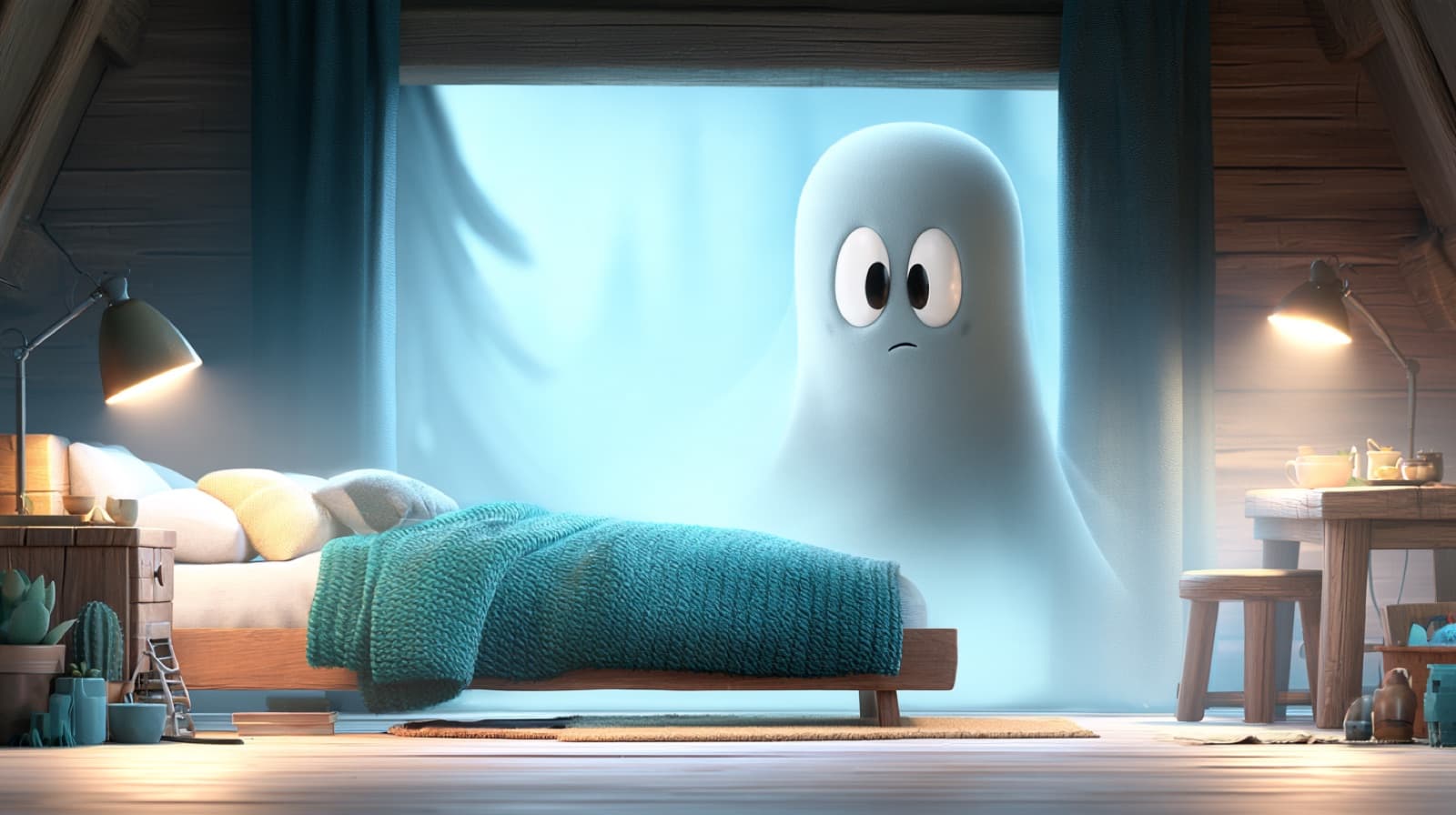
Yes. A video game is rules and a way to win, and your kid can design both on paper, draw one level, and have someone play it before anyone writes code. This page is the parent's case for starting on paper. For the step-by-step version your kid watches, the free course How to make a video game has six short films, one for each department in Game Studio. The example here is a haunted house: a three-room escape your kid makes in Game Studio. The method works the same in March.
What is a video game, before any code?
A video game is a set of rules with a way to win, and the code comes later. Kafai and Burke (2015) reviewed 55 studies of children making their own games and found that "when children make games, they are making first and foremost for the sake of playability." Game Studio puts the same idea first on its page: "Every game needs a goal: a hero who wants out, something in the way, and a way to win."
There are two kinds of projects for kids. The first kind ends on the fridge door. The second kind ends as a real thing other kids can read, watch, or play. Kubrio makes the second kind. Kids make them by directing the same AI the pros use.
Why should your kid design a game on paper first?
Paper is where a rule costs nothing to change. Saiger, Deterding, and Gega (2023) reviewed 47 studies in which researchers designed games with children, and paper prototyping was the most common activity, in 20 of them (43%). Playtesting came up in 14 (30%). The escape game starts the same way: your kid draws on paper first and snaps the drawing in the app.
Code alone doesn't make a game playable. Denner, Werner, and Ortiz (2012) analyzed 108 games made by middle school girls in an after-school class. The girls used real programming concepts, and their games still had "moderate levels of usability." Designing for a player is its own skill, and it's the one Game Studio puts first.
How do you draw the hero and the villain?
Draw each one on its own page, by hand, and give the villain one behavior. The villain chases, blocks a doorway, or sleeps until something wakes it. If your kid wants a warm-up, Kubrio's free guides on how to draw a haunted house and how to draw a ghost take six steps each.
In Game Studio, the kid draws the hero and the villain and names them, and the AI turns those drawings into game characters.
How do you write the rules and the way to win?
Write each rule on its own card as "When this happens, do that." One example: when the ghost touches you, you go back to the door. Make one card for the hero, one for the ghost, and one for the key and the door. The win condition is the last card: when you carry the key to the door, you escape. Three to five cards make a whole game. In the escape game, the key and the locked door are that win condition.
Game Studio's line is "Every power is a rule: when this happens, do that," and your kid picks every power card. The AI suggests a starting set from your kid's words, and "your kid can change anything it suggests." That's what the hand stays the hero means here: the kid owns every rule.
How do you build a paper room the family can play?
Draw one room from above on grid paper, then play it with coins. Mark the start, the door, the key, the walls, and one danger square. Put the key somewhere the player can see before the door matters. One person moves the hero one square a turn, and a parent plays the ghost. The rule cards decide what happens. The escape game uses the same pieces: a key, a locked door, and a ghost that chases.
Mitchel Resnick of the MIT Media Lab describes his own lab's rule in his 2007 paper on creative thinking: "storyboards are not enough; we want functioning prototypes." In Game Studio, your kid says what goes in each room, then drags the key, the door, and the platforms into place. "One room is a playable game, and three is the full house."
How do you playtest a game with your kid?
Hand the room to someone who didn't design it, and have the designer watch without talking. Here is the script:
- The designer explains the goal in one sentence, then stops.
- The player plays and says out loud what they're trying.
- The designer writes down every place the player stops, asks a question, or says "wait."
- Afterward, ask three questions. Where did you get stuck? What did you think the key did? What did you try that didn't work?
Hattie and Timperley (2007) summarized at least 12 meta-analyses covering 196 studies and found feedback averaged an effect of 0.79, twice the typical effect of schooling (0.40). Praise alone scored 0.14. "The ghost caught me before I saw the key" is feedback. "Great game!" is praise. When the escape game is finished, the family plays it from a link, so every room meets a real player.
Kafai (1995), as Kafai and Burke report, studied sixteen fourth graders who spent six months designing fraction games for third graders. They debugged and revised especially after testing sessions with the younger kids, and they scored significantly better on fraction tests than a comparison group.
What if nobody can beat the first room?
That's a normal first draft, and the fix is the lesson. Kapur (2016) reviewed studies in math and science classrooms where students who tried a problem before being taught understood the idea better afterward. His line: "it does not matter if students do not achieve successful problem-solving performance initially." Game Studio's AI checks that every room can be beaten because first rooms often can't.
Change one thing, then play again. If the ghost catches everyone in two seconds, slow the ghost or move the key, not both, so the next round tells you which fix worked. In the Kluger and DeNisi (1996) data that Hattie and Timperley summarize, feedback about changes from a previous try scored 0.55, against 0.28 without it.
When does the code come in?
Code comes in when the design holds up and your kid wants to type the rules in themselves. Denner, Campe, and Werner (2019) looked at 68 articles and found "some evidence" that making games can change programming knowledge and problem solving. Most studies "did not measure learning," and several noted more negative attitudes toward programming afterward. Start where the fun is, then add code, which is why Game Studio starts with drawings and rule cards.
For the code step, read how to introduce your kid to coding, which covers the first three sessions. The free Code with Blocks guides run in the page with no login. A power card in block code is an event: start with What is an event? and What happens when things bump?, then loops and events together.
What to do at home this week
- Draw the hero and the ghost on two pages. Name them.
- Write three rule cards and one win card, each as "When this happens, do that."
- Draw one room on grid paper with a start, a key, a door, and one danger square.
- Play it with coins. A parent plays the ghost.
- Run the playtest script with someone who didn't design it.
- Change one thing and play again. Keep the old version.
- When one room works, draw the second.
Ingenious projects that inspire kids to make things — until they find the thing only they could make.
Make an escape game: your kid draws the hero and the villain, picks every power card, and ends with a three-room haunted house game the family plays from a link. Or watch the free course How to make a video game first, then start here.
FAQ
Can you make a video game without coding? Yes. The rules, the level, and the playtest are the game design, and all three work on paper. Code is how the computer runs the rules later.
What age can a kid start making their own game? Six. At 6 to 7, keep it to one room and two rules, with a parent as the ghost. At 8 to 10, kids design a room alone with three or four rules and have a sibling test it. At 11 to 13, try three rooms where each key opens the next room, which is a good age to add code.
How long does it take to make a video game? One paper room takes a sitting. A game other people can finish takes a few rounds of testing. The escape game in Game Studio takes a few sittings, and one room is already a playable game.
Is a haunted house game too scary for a young kid? It doesn't have to be. Your kid draws the ghost, so your kid decides how scary it looks. In the escape game, the ghost chases, and it never hurts anyone.
What do I say when my kid's game is too hard to beat? Say what happened, not whether it's good: "The ghost reached me before I saw the key." Then ask what they want to change, and let them pick the fix. Don't move the key yourself.